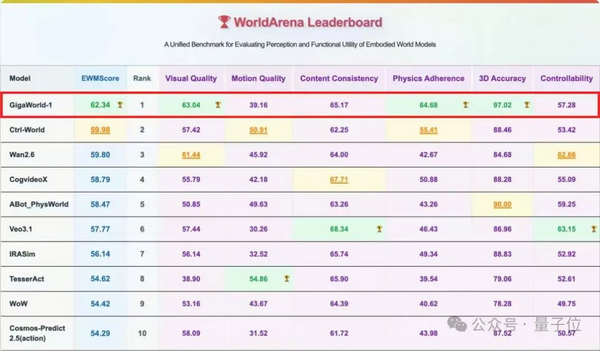
Recently, Haidian-based enterprise GigaAI has once again achieved a major upgrade with its embodied world model. Its GigaWorld-1 model triumphed over top international tech giants and academic institutions on the WorldArena Leaderboard, the leading authoritative evaluation benchmark in the field, claiming the top spot globally and becoming the only embodied world model on the list to achieve an overall score exceeding 60.
The WorldArena evaluation was jointly developed by Tsinghua University and several other top domestic and international universities, establishing a comprehensive assessment system comprising 16 core sub-metrics and three real-world application tasks. It is designed to rigorously assess embodied world models in areas such as perception accuracy, understanding of physical laws, 3D spatial reasoning, and action prediction and execution.
As a result, this evaluation has attracted nearly all leading world model teams globally to compete on the same stage, with early participants including Google, NVIDIA, and others.
What Is an "Embodied World Model"?
Traditional robot learning relies on collecting massive amounts of real-world data, which is inefficient and costly, often leaving robots "at a loss" when facing complex and ever-changing real-world environments. GigaAI's breakthrough lies in its core technology—the world model.
By generating high-fidelity, controllable, and diverse interactive data within a virtual environment, the world model achieves "data amplification". This allows robots to evolve through self-improvement at ten to 100 times the data and training efficiency in a virtual setting, reducing the need for extensive trial-and-error attempts in the real world.
In essence, it functions as an extremely realistic "digital world simulator".
It enables robots to construct an interactive, predictable "imagination space" that adheres to the laws of physics. Within this space, robots can engage in unlimited trial and error, simulate future scenarios, assess risks, and then execute tasks seamlessly in the real world.
In short, GigaAI's GigaWorld-1 model transforms robots from being able to only passively "see" what is in front of them to actively "foresee" the future, enabling them to make smarter and safer decisions.
Giving Robots an "Imagination Engine"
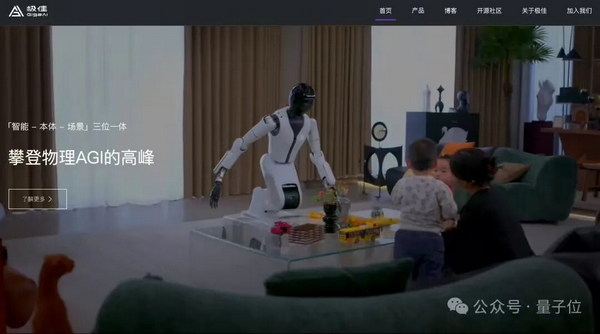
As one of the pioneering enterprises in China to systematically deploy world models, GigaAI likens its technology to a "data engine" and an efficient "mental simulation system" for robots.
In terms of model architecture, the GigaBrain series of embodied foundation models released by GigaAI ranks among the global leaders. Its open-source model, GigaBrain-0.1, achieved outstanding results in February this year at RoboChallenge, a large-scale real-world embodied intelligence evaluation platform, securing second place globally overall and ranking first in the "dual-arm coordination" task, demonstrating exceptional capabilities in long-horizon, complex tasks.
Additionally, the GigaWorld-Policy embodied policy model released by GigaAI has achieved comprehensive breakthroughs in real-time performance, training efficiency, and task success rates. Measured data shows that compared to mainstream WA models, this model delivers approximately a ten times improvement in inference speed, roughly a ten times increase in training efficiency, and boosts success rates by about 30 percent in typical manipulation tasks.
Synergy Between "Brain" and "Body" to Bridge the "Last Mile" of Deployment
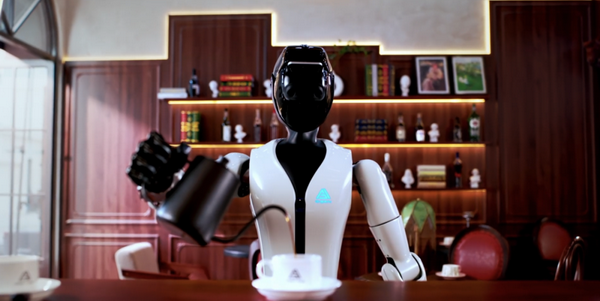
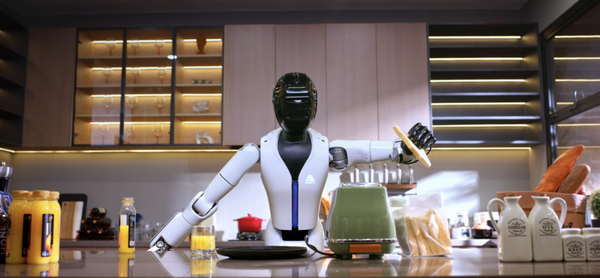
A powerful "brain" alone is not enough; it needs a flexible "body". On November 26, 2025, GigaAI released its fully self-developed next-generation physical AGI native embodiment—the Maker H01. This dual-arm mobile robot is not a mere stacking of hardware, but rather a "data entry point" specifically designed for a data closed loop.
According to reports, the Maker H01 adopts a structure combining dual arms with a mobile chassis. Its head is equipped with a binocular RGB-D camera, while the torso and wrists are supplemented with blind-spot cameras. The chassis is fitted with an omnidirectional LiDAR, enabling 360-degree environmental perception. With over twenty degrees of freedom across the robot's body, paired with multi-fingered grippers capable of handling kilogram-level loads, it is well-suited for precision manipulation and compliant control tasks.
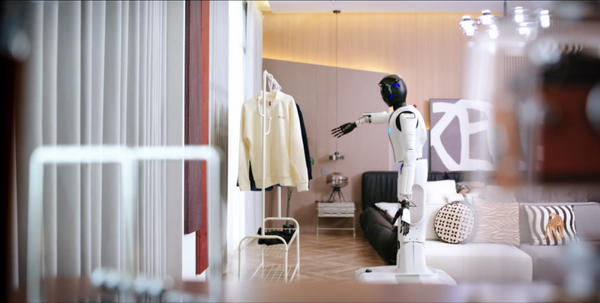
"For every Maker H01 deployed in real-world scenarios such as automotive manufacturing, 3C electronics, and warehousing logistics, operational data is annotated and augmented through the 'world model-driven embodied AI data factory combining virtual and real environments.' This data is then fed back into the training of embodied foundation models like GigaBrain, forming a continuous evolution flywheel of 'scenario-data-model,'" a representative from GigaAI told reporters. As of January 2026, GigaAI has initiated the first batch of large-scale production and delivery of the Maker H01 robot, and plans to strive for an annual delivery volume of 1,000 units throughout 2026.
Nearly One Billion Yuan Raised in Pre-B Round Early This Month
Behind this achievement lies the strength of GigaAI, a "dream team" born in Haidian. As the first company in China specializing in world models, GigaAI maintains close ties with the Intelligent Vision Group of the Department of Automation at Tsinghua University. The founder and CEO, Huang Guan, holds a Ph.D. from the Department of Automation at Tsinghua University, previously served as Head of Visual Perception Technology at HorizonRobotics, and was a partner at PhiGent Robotics. He has worked at top institutions such as Microsoft Research Asia and Samsung Research China, and has led teams to multiple global AI championship titles. He possesses extensive experience in technological innovation, industrial implementation, and serial entrepreneurship in the field of physical AI.
The core team brings together former technical executives from major internet companies, recipients of Huawei's "Genius Youth" program, and research and production experts from leading domestic robotics firms. Together, they have experienced the full technological evolution from the era of computer vision and autonomous driving to the current age of embodied AI. Having collectively led the R&D and delivery of several thousand humanoid robots, they are widely regarded as a "dream team" in the field of physical AGI.
Huang Guan said, "From research outcomes at Tsinghua's laboratories to becoming a leader in the industry today, we have deeply felt Haidian District's strong support in technological innovation and industrial transformation." GigaAI's latest global achievement not only demonstrates the original innovation capabilities of Haidian-based enterprises in cutting-edge technology but also further strengthens the esteemed "Haidian AI" brand.
Earlier this month, GigaAI announced the completion of a nearly one billion yuan Pre-B round funding round. Investors include top-tier chip and automotive industry funds such as China Fortune-Tech Capital, Shanghai Semiconductor Equipment and Materials Industry Investment Fund, Sunic Capital, Star Origin and Wanlin International, as well as major state-owned investment platforms and renowned financial institutions including China Capital Investment Group, Suzhou Capital Group, and Hua Qiang Capital. GigaAI is widely seen as a frontrunner poised to usher in the "ChatGPT moment" for the physical world.