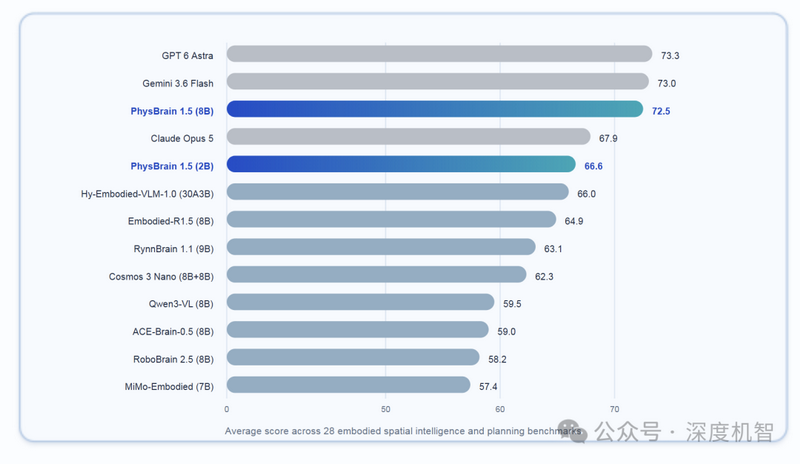
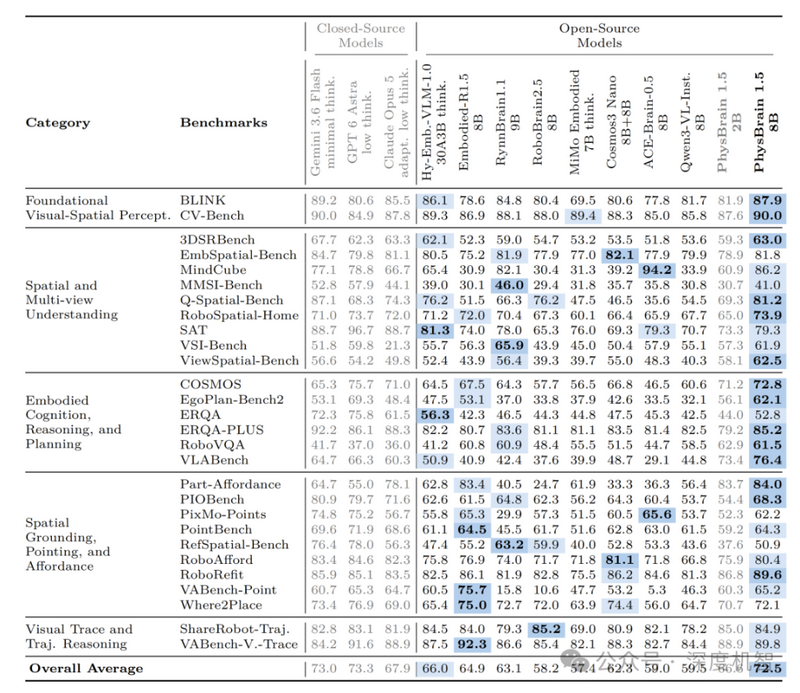
On September 9, Deepcybo officially released the foundation model PhysBrain 1.5. With a parameter scale of 8B, the model achieved an overall average score of 72.5 across 28 embodied intelligence evaluations, of which 14 items reached the current best level among open-source models, and 10 items ranked second among open-source models, delivering a phased report card ranking first globally among open-source models.
The evaluation covers five categories of capabilities: basic visual-spatial perception, spatial and multi-view understanding, embodied cognitive reasoning, spatial pointing and affordance, and visual trajectory reasoning. Among these, RoboSpatial-Home spatial understanding scored 73.9 points, Part-Affordance operable part recognition scored 84.0 points, and RoboReflt visual target localization scored 89.8 points. In the same-field comparison, its average score was 6.5 points higher than Hy-Emb-VLM-1.0 and 9.4 points higher than RynnBrain 1.1(9B).
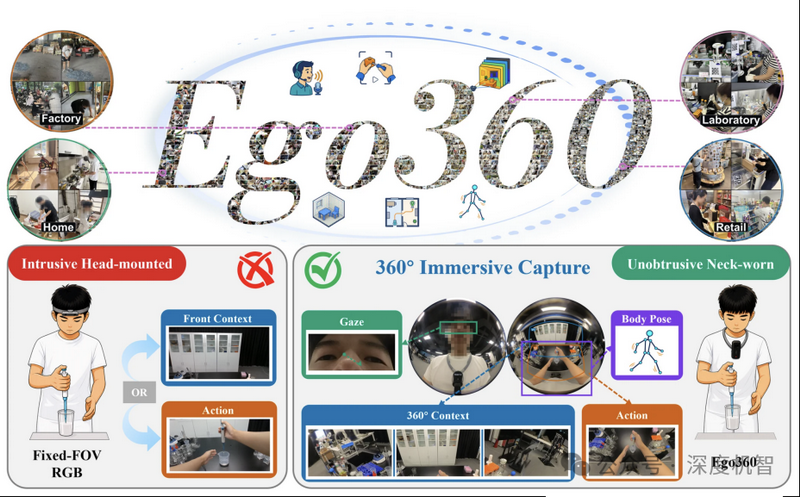
In terms of technical architecture, PhysBrain 1.5 centers on the Physical Loop (physical intelligence loop), unifying six core capabilities — semantic understanding, spatial perception, object recognition, dynamic generation, action generation, and closed-loop feedback — within the same model framework, advancing a physical foundation model (PFM) that takes VLM as the cognitive foundation and integrates spatial, temporal, object, action, and world dynamic modeling. At the data and training level, Ego360's human-centered panoramic collection system adds tens of thousands of hours of real-world physical experience monthly. ActionPiece transforms continuous actions from different robots and different sampling frequencies into action units learnable by large models. Through shared backbones and unified vocabularies, the model jointly trains understanding, action generation, and future state prediction, improving action prediction capability from 24% to 54%.
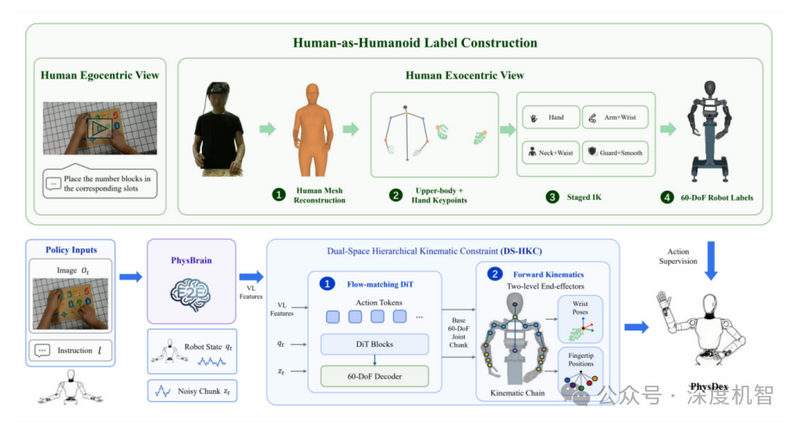
In the Human-as-Humanoid research, the team transforms synchronized first-person and external-view human videos into 60-DoF action training data adapted for Prime U. The original demonstration throughput reaches 4.8–7.2 times that of teleoperation, and some tasks can achieve transfer from human data training to real-machine execution without target robot demonstrations.
The strategic significance of this work lies in enabling human data to further become training resources usable for action learning. As this transformation chain expands, model training will have the opportunity to reduce reliance on robot task-by-task demonstration collection and access broader human work experience.
Globally, Google DeepMind, Generalist, Figure, Physical Intelligence, and others are all accelerating their deployment of physical experience data and foundation models. Deepcybo released its “From Human, Beyond Human” development strategy on October 10, 2025, advancing a full-stack strategy of human data infrastructure, model capability R&D, and embodiment closed-loop verification through the “human learning” approach. Among these, Ego360 provides continuous physical experience data, continuously enhancing PhysBrain's model capabilities; the Prime series embodiments provide real-world interaction and verification conditions. Progress in each link amplifies the value of the other links, and each iteration cycle shortens the transformation path from “human experience” to “machine capability. ”
Deepcybo stated that the significance of PhysBrain 1.5 is that this full-stack system is continuously driving breakthroughs in model capabilities. Going forward, the Company will advance more complete native unification of understanding and generation, enabling spatial cognition, interactive decision-making, action generation, and world prediction to co-evolve within the same physical foundation model. The ultimate goal of physical intelligence is not a model that can answer questions, but a closed loop that can perceive, act, and continuously self-correct in the real world. PhysBrain 1.5 is yet another report card delivered on this path.