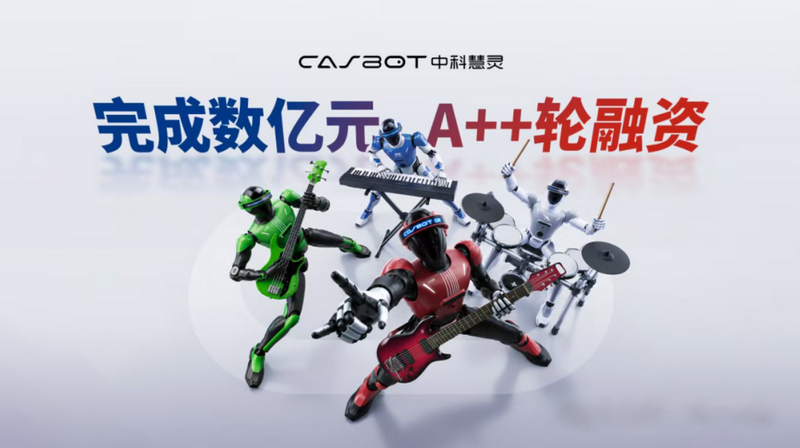
First, robots are sent underground into mines to load explosives; then, four robots form a band and take the stage to perform; now, robotic arms are being deployed in a shoe factory in Putian to stamp insoles… This Haidian-based company, spun off from scientific and technological achievements at the Institute of Automation of the Chinese Academy of Sciences, has blazed an embodied intelligence deployment path that goes "from special scenarios to commercial performances, and further into flexible manufacturing." Recently, Haidian embodied intelligence company Beijing Zhongke Huiling Robot Technology Co., Ltd. (hereinafter referred to as "CASBOT") announced the completion of hundreds of millions of yuan in A++ round financing, jointly invested by institutions including Zhilai Investment, Yonghua Capital, Maotian Investment, Oriza FoFs, Guoke Kezhi, and Luning Investment. The funds will primarily be used for mass production and delivery of products, R&D and iteration of embodied brain technologies for key scenarios, and market expansion.
Advancing Validation in High-Risk Operational Scenarios
In complex underground mining environments, CASBOT's robots are advancing on-site training and application validation of embodied intelligent robots around high-risk procedures such as explosive loading. This is a phased achievement of CASBOT's mining robot R&D. Founded in 2023, CASBOT has established a full-stack self-developed system of "body + embodied brain + dexterous hands." In 2024, the CASBOT team officially launched mining robot R&D; in mid-2025, the team entered mining scenarios to conduct field testing; and in May this year, the relevant technology system completed underground physical validation. Currently, the mining explosive-loading robot has entered a real mine for on-site training, and the team continues to advance technology R&D and scenario validation around underground explosive loading, cable harness operations, and collaborative work with other intelligent mining equipment.
"Robots should be the first to go to dangerous posts and safeguard human life and safety," said Zhang Zhengtao, founder and chairman of CASBOT. Underground mines are dusty, humid, and have unstable communications — posing severe challenges to a robot's environmental adaptability, remote operation, and safety redundancy. CASBOT chose to first place its robots in highly challenging scenarios for technical validation, honing product capabilities through real tasks.
Forming a Robot Band
Under the spotlight on stage, a robot band plays guitar and beats drums, drawing cheers from the audience. This scene under the spotlight originated from a "test question" designed to verify the capabilities of dexterous hands. Beyond mining, CASBOT also put robots on stage. Zhang Zhengtao recalled: "At the time, someone asked us how we could prove the reliability of our dexterous hands. So we had them play the piano, benchmarked against the national Level 10 standard. Later, we took it a step further and formed a band, with four robots performing in coordination — showcasing dexterous hands, string plucking, force control, multi-robot coordination, and whole-body motion control."
According to Zhang Zhengtao, the band's repertoire now includes nearly 100 songs, with new pieces able to be composed and distributed to all four robots in just over ten minutes. The band has appeared at major events including the BRTV Spring Festival Gala and the Zhongguancun Forum, representing Chinese robotics in international exchanges. The motion and coordination data accumulated from precise manipulation and millisecond-level beat synchronization, in turn, support embodied model training. First validating technology in rigorous scenarios, then testing capabilities through performances — CASBOT uses two vastly different scenarios to test the same technological foundation.
Total Orders Exceed 400 Million Yuan
After accumulating experience in mining and on stage, CASBOT extended embodied intelligence into footwear and apparel manufacturing — a typical flexible manufacturing scenario. In the shoemaking workshop of a leading footwear enterprise, robots are being evaluated down to the second. In related process tests, stamping an insole took 7 seconds, and pressing a pair of soles took 18 seconds. Based on current project estimates, the annual return on investment for this solution is approximately 50% to 70%, with an expected payback period of under two years.
Zhang Zhengtao told reporters that when shoe uppers, tongues, and soles arrive at the workstation, their edges, wrinkles, positions, and orientations often change. Traditional automation relies on fixed trajectories and preset programs, making it difficult to fully cover such variations. CASBOT's solution is to have robots adjust their motions based on real-time perception — its self-developed lightweight CASBOT PA (perception-to-action) model directly connects visual perception to action generation: first identifying the current state of materials, then generating corresponding actions, and finally driving the robot's actual execution through kinematic processing. Robots no longer rely on fixed settings like "move to X centimeters at second Y," but instead adjust dynamically based on on-site conditions.
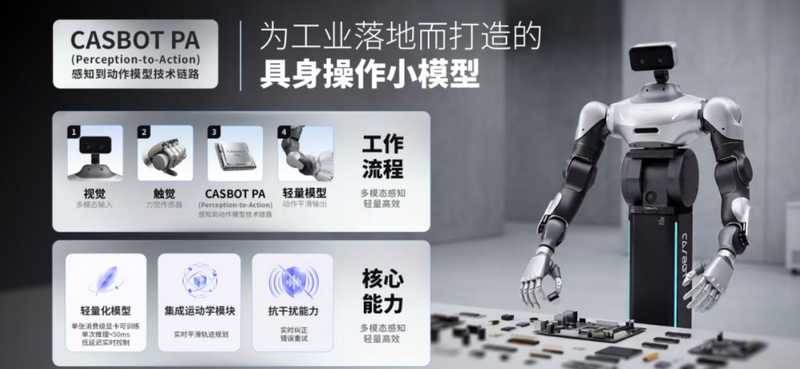
This model can be trained on a single consumer-grade GPU, has low inference latency, and features real-time error correction and failure retry capabilities. CASBOT plans to open-source it in the second half of 2027, aiming to lower the threshold and cost for development teams to deploy robot applications on-site. At a real shoemaking workstation of a leading footwear enterprise in Putian, CASBOT PA is being validated for application using robotic arms as the carrier — and those 7-second and 18-second cycle times are the phased results this technology has delivered in real production tasks.
Whether technology can be deployed is powerfully tested by market orders. Zhang Zhengtao revealed that in 2026, the company has signed embodied shoemaking robot orders totaling over 400 million yuan, with equipment production scheduling reaching the scale of thousands of units. From a small number of devices entering workstations to orders at the thousand-unit level, the core question has shifted from technical feasibility to productization and engineering capability: whether the technology can be replicated stably and at low cost across more processes and factories. CASBOT is advancing along the "model–body–scenario" path, improving the reuse rate of models, skills, and engineering modules, and driving capabilities validated at one workstation to reach more production lines faster.
Real-World Scenarios Drive Technological Maturity
Regarding this round of financing and the company's development path, Zhang Zhengtao stated: "The value of embodied intelligence must ultimately be tested in the real world. We choose to go deep into complex scenarios such as factories and mines, continuously honing products, accumulating data, and enhancing capabilities through real tasks." Hao Wenju, Chairman of Zhilai Investment, believes that CASBOT has formed full-stack capabilities in embodied brains, motion control, dexterous hands, and complete machines, and has carved out a clear commercialization path in fields including industrial manufacturing and mining energy. Tang Zheng, Managing Director of Yonghua Capital, stated: "CASBOT has gone deep into vertical fields such as footwear and apparel manufacturing, where demand is clear and return on investment is quantifiable, forming a differentiated competitive advantage."
Zhang Zhengtao stated that next, CASBOT will advance product and model iteration around industrial embodied intelligence, commercial embodied intelligence, specialized embodied intelligence, and embodied foundation models, expand into scenarios including mining, power, and transportation, and grow science education and entertainment markets in the Middle East, Europe, Southeast Asia, and North America. From loading explosives underground in mines to coordinated performances on stage, and further to flexible workstation operations in shoe factories, this Haidian company is demonstrating through one real-world scenario after another: embodied intelligence is not a concept confined to laboratories, but a productive force capable of entering mines, taking the stage, and entering workshops.