The 2026 World Internet Conference (WIC) Distinguished Contribution Awards were announced at the opening ceremony of the Wuzhen Summit on Nov. 3. The awards honor individuals and enterprises that have made outstanding contributions to internet-related fields worldwide. This year, more than 230 enterprises from nearly 20 countries and regions applied, covering artificial intelligence (AI), information and communications, robotics, healthcare and other fields. Following expert review, two individuals and 15 enterprises received the awards.
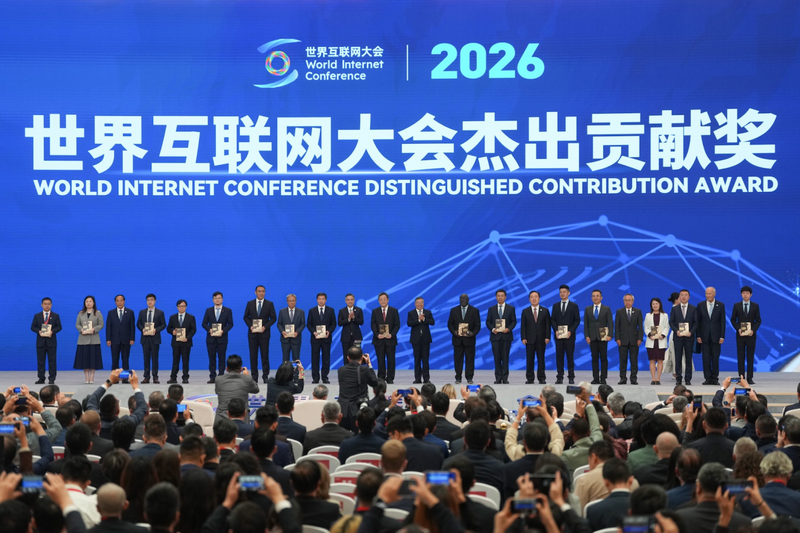
On this global list, Haidian District had one academician and four companies honored: Wu Jianping, academician of the Chinese Academy of Engineering and professor at Tsinghua University, received the individual award; Baidu was selected in the social contribution category; Moore Threads and Xiaomi were selected in the innovation breakthrough category; and OceanBase was selected in the growth potential category. One academic giant and four industry benchmarks — from basic network research to AI software applications, from database foundations to chip hardware — Haidian achieved a "full-chain showcase" in this global selection.
A Pioneer of China's Internet
Wu Jianping, the individual award winner, is one of the main pioneers of internet engineering and technology in China. The conference recognized him for his outstanding contributions to the development of the internet in China and the Asia-Pacific region and to leading global innovation in next-generation internet technology, noting his significant international influence.
Many people go online every day without thinking about one question: every data packet carries a "sender's address," so how does the receiver verify whether it is genuine? Wu's research focuses on exactly this issue: trusted verification of data packet identity.
But before conducting his research, he took the lead in building China's basic internet infrastructure. In 1994, Wu Jianping spearheaded the construction of CERNET, the China Education and Research Network. The following year, this national backbone network — with a bandwidth of just 64K — covered eight key cities across the country, connected 108 universities, and served 30,000 early internet users. In 2004, CERNET2 was officially completed and opened, becoming the world's largest pure IPv6 next-generation internet backbone network at the time.
What truly established Wu as a global authority on the internet, however, was his nearly 20-year effort on source address validation. Wu once explained it with a simple analogy: people need identity documents in social activities, or problems cannot be traced; network data packets likewise need a trusted identity. Starting in 2005, he led his team in overcoming doubts from many sides, proposed the Source Address Validation Architecture (SAVA), and developed eight related international standards. The core next-generation internet technologies developed under his leadership have been applied in more than 50 network devices from major manufacturers in China and abroad, and deployed on CERNET, China Telecom's IPv6 backbone and several 5G industry private networks. For this achievement, Wu's team won the First Prize of the National Science and Technology Progress Award.
In 2010, Wu received the Jonathan B. Postel Service Award, becoming the first Chinese scientist to win this highest honor of the international internet community. In 2017, he was inducted into the Internet Hall of Fame in the "Global Connectors" category. From CERNET to SAVA, this is the cause that Wu's team has continued to advance.
AI with Warmth, Data with a Solid Foundation
Baidu, the winner in the Social Contribution category, is headquartered on Shangdi 10th Street in Haidian District. The conference recognized the company for applying AI to endangered species protection and exploring a new technology-based path for ecological governance.
From search engine to AI, Baidu reflects the transformation of Haidian's software industry. In recent years, illegal wildlife trade has become one of the main threats to global biodiversity. Since 2020, Baidu has worked with the International Fund for Animal Welfare (IFAW) on the "AI Guardian of Endangered Species" project. Powered by Baidu's PaddlePaddle deep learning platform and ERNIE large models, the project has gone through several rounds of technical upgrades and can now automatically identify images of endangered wildlife products, with an accuracy rate of 86% across 34 categories of endangered species and their products.
As of April this year, the project had helped screen nearly 500,000 images, accurately identified more than 50,000 target images, and helped remove nearly 18,000 illegal trade advertisements. The identification model has also been open-sourced on PaddlePaddle and is available free of charge to public welfare organizations and law enforcement agencies worldwide. The project had previously been included in the United Nations "AI for Good" case collection and won international honors including a Silver Edison Award.
Ecological protection is only one example of Baidu's long-term commitment to corporate social responsibility and "tech for good." Many of Baidu's innovative practices in promoting coordinated global governance of technology and society have been recognized internationally. While advancing its full-stack, self-developed technologies across chips, cloud, models and agents, Baidu remains committed to its mission of "making the complicated world simpler through technology."
OceanBase, the winner in the Growth Potential category, is a self-developed AI data platform under Ant Group. The conference recognized it for building AI data infrastructure that serves the development of the global digital economy.
Founded in 2010, OceanBase started out supporting payment peaks during the "Double 11" shopping festival. It broke the TPC-C world record in both 2019 and 2020 and also topped the TPC-H benchmark. It is the world's only native distributed database to have set world records in both TPC-C and TPC-H, two authoritative benchmarks, and now serves more than 4,000 customers in finance, government services, telecommunications, retail, the internet and other sectors.
Hard Tech: Building Foundations and Reaching Households
In the Innovation Breakthrough category, both Haidian winners are hard-tech players. Xiaomi was recognized for integrating self-developed chips, AI, OS and robotics to explore more possibilities in the intelligent era.
Since releasing its Xiaomi MiMo large model, Xiaomi has built a model portfolio covering language, multimodal, speech and embodied intelligence, and has opened these capabilities to a wider range of developers and industry partners through full open-sourcing and MIT commercial licensing.
In chips, after more than a decade of continuous research and development, Xiaomi launched its self-designed XRING O1 flagship chip, becoming the first company in the Chinese mainland and the fourth in the world to release a 3nm flagship mobile phone chip. In August this year, Xiaomi launched three chips of its new-generation XRING family at once. Among them, the AI flagship SoC XRING O3 has built-in AI acceleration hardware in all modules and became the industry's first flagship SoC to score over 5 million points on AnTuTu.
In operating systems, Xiaomi HyperOS uses a unified, integrated kernel architecture to connect phones, tablets, watches, TVs, smart home devices, cars and other devices, unifying the technology stack across the entire "Human x Car x Home" ecosystem. The latest HyperOS 4 has received an in-depth AI upgrade in core experience, features and ecosystem-wide AI.
Moore Threads was recognized for developing general-purpose, full-featured GPUs and providing accelerated computing infrastructure for the world. Founded in 2020 and registered in Haidian, the company has launched five generations of GPU chip architecture in five years. Its self-developed MUSA unified system architecture allows a single chip to support AI computing acceleration, graphics rendering, physics simulation, scientific computing and ultra-high-definition video encoding and decoding.
On Dec. 5, 2025, Moore Threads was listed on the STAR Market as "the first domestic GPU stock." Several key indicators of its KUAE 10,000-card intelligent computing cluster have reached mainstream international levels, providing a computing power foundation for training and inference of Chinese large models.
One company coordinates AI, chips and OS; the other focuses on full-featured GPUs. One serves millions of households; the other supports industrial infrastructure. Haidian's hard tech both reaches for the frontier and stays grounded in real-world needs.
Awards Are the Result, the Ecosystem Is the Soil
Of the 17 places on the global list, Haidian took five. What gives Haidian this strength in a global selection? The answer lies in its industrial ecosystem.
In terms of industrial foundation, Haidian is currently home to more than 2,000 AI enterprises and 34 unicorns, and has 160 registered large models, accounting for about half of Beijing's total. In terms of development position, the "Beijing Haidian Artificial Intelligence Cluster" was named a national advanced manufacturing cluster in 2024, becoming China's first AI industry cluster. The Zhongguancun Science City's Action Plan for Panoramic Empowerment of Artificial Intelligence aims to make Zhongguancun Science City "the leading city for comprehensive AI empowerment."
Taken together, the list of winners is a concrete picture of this ecosystem. Wu Jianping's lab focuses on "0 to 1" fundamental research, Baidu's large models drive "1 to 100" application, OceanBase's database secures the "data foundation," Xiaomi's chips and devices bring technology "into millions of households," and Moore Threads' GPUs strengthen "self-reliant and controllable computing power." Fundamental research, software applications, data infrastructure, smart hardware and computing power support: no link is missing. Awards are the result, and the ecosystem is the soil. As the spotlight in Wuzhen fades, the ecosystem continues to grow in Haidian.