【Innovation Term】Sci-Tech Innovation Going Global Parlor
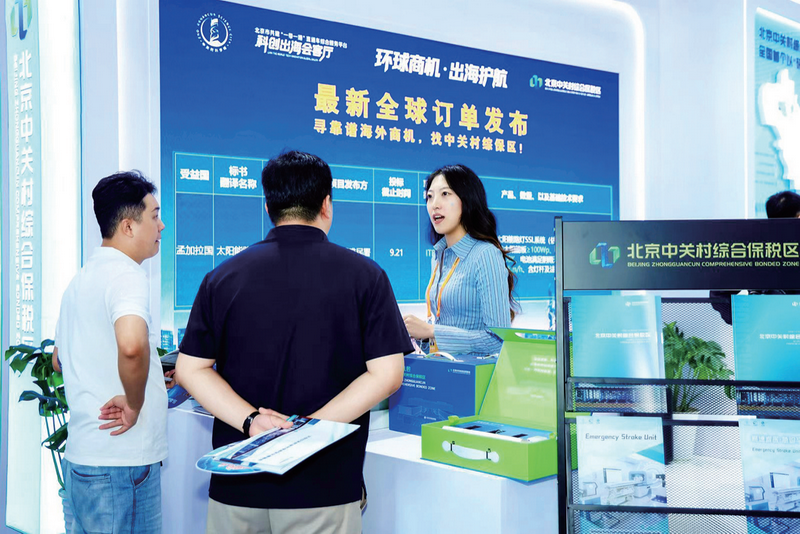
The Sci-Tech Innovation Going Global Parlor is the fourth offline parlor established by the Beijing Belt and Road Comprehensive Service Platform and Beijing's first official physical service platform for sci-tech enterprises going global. It was officially unveiled at the Beijing Zhongguancun Comprehensive Bonded Zone in March this year and began physical operations in May. It is more than a room: it works as a service mechanism that prepares sci-tech enterprises for international markets. Enterprises walk in with a "problem list" and walk out with a "navigation map"—that is the parlor's most ordinary daily routine.
Unlike ordinary going-global consultancies that merely "point the way," the Zhongguancun Sci-Tech Innovation Going Global Parlor acts more like a "running companion." From policy matching and compliance support to order matchmaking and follow-through on the ground, it steps in across the whole process and provides closed-loop services. The parlor integrates municipal and district-level policy resources, international institutional resources, and professional service resources to build a "1+5+N" sci-tech going-global service system. The "1" is the one-stop service platform of the Beijing Zhongguancun Comprehensive Bonded Zone, focused on handling "bonded matters" and "going-global matters" efficiently, with customs, foreign exchange, and tax experts stationed on site to solve problems face to face. The "5" refers to five support pillars—policy, facilitation, orders, services, and talent—covering the entire going-global process. The "N" links multiple overseas innovation sites and service institutions around the world, weaving an ever-wider network of international resources.
【Zhongguancun Exploration】
Inside the Beijing Zhongguancun Comprehensive Bonded Zone, there is a special parlor. Enterprises come with a "problem list" and leave with a "navigation map." In this small space, intangible services that connect to global markets converge, building bridges for sci-tech enterprises and helping them set sail.
From "Problem List" to "Action List"
A robotic arm rotates, lowers a cup, grinds, extracts, froths milk, and pours latte art… About 50 seconds later, a latte is ready. "The coffee made by the robot tastes not much different from what a cafe makes on site," one customer said after tasting it.
This "AESIR coffee agent—AE-SF series" beverage robot, integrating a six-axis human-machine collaborative robotic arm, an independent robotic arm control system, and AI latte-art algorithms, was independently developed by Beijing AESIR Intelligent Technology Co., Ltd., a Haidian sci-tech enterprise. As planned, the equipment will appear on the streets of Thailand in a few months and gradually enter other Southeast Asian markets.
The going-global direction was not a snap decision. Jiao Chen, marketing manager at AESIR Intelligent, said research shows that coffee consumption habits in Southeast Asian countries are relatively mature. For example, in Thailand, per capita consumption is one cup per day, with annual per capita consumption exceeding 300 cups, indicating considerable market potential. At the same time, local coffee import prices are relatively low, leaving room for cost competitiveness.
Once the opportunity was clear, the difficulties concentrated at the implementation level. For AESIR Intelligent, which is going global for the first time, a series of new problems had to be tackled one by one—from customs registration, foreign exchange account opening, and export tax rebate registration to contract terms, and even whether the coffee robot should be classified as food-processing equipment, a vending machine, or an industrial robot.
After the parlor began physical operations, Jiao Chen booked an expert consultation through the mini-program of the Beijing Belt and Road Comprehensive Service Platform. On site, an enterprise going-global strategy consultant who had participated in multiple overseas listings and cross-border M&A projects for Chinese companies, a tax expert specializing in cross-border tax issues for small and medium-sized enterprises, and an international intellectual property manager proficient in patent filing and portfolio planning analyzed the company's situation item by item, helping it clarify its thinking and define a path.
"The experts have hands-on experience in going global and flagged many risk points we had not noticed before, which gave us more confidence," Jiao Chen said. The consultation amounted to drawing a going-global "navigation map," making the key points and risks of equipment export clearer, and turning the original "problem list" into an "action list."
Bringing Global Business Opportunities Directly to Enterprises
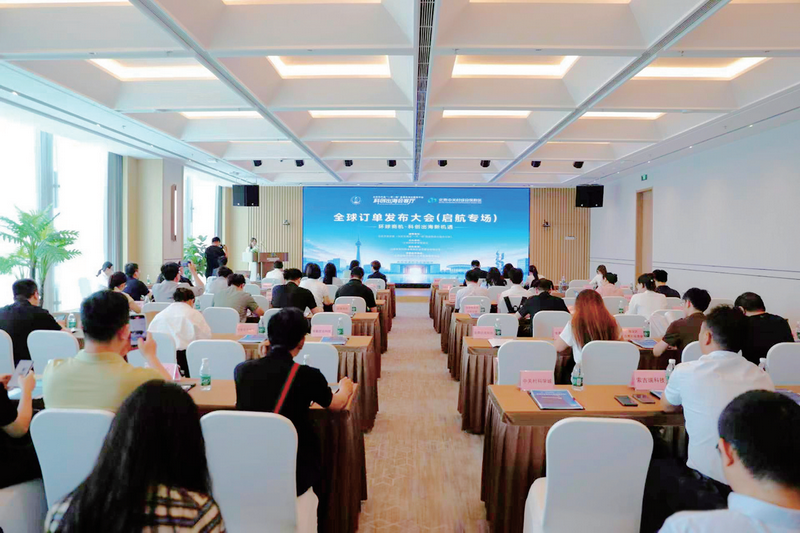
On an autumn afternoon, the Sci-Tech Innovation Going Global Parlor was full, with a Global Order Release Conference underway. More than 100 business opportunity projects from over 40 countries were released on site, spanning industrial equipment and tools, medical laboratory equipment and pharmaceuticals, commercial communications technology equipment and supplies, and other fields, allowing enterprises to connect with global opportunities without leaving the park.
"We previously thought the threshold for UN procurement was high, but after attending, we found that our AI solutions are a good match for smart city project needs," said the head of a Haidian enterprise engaged in intelligent security.
Qian Xingzhu, head of the parlor, said Beijing's sci-tech enterprises have a strong desire to go global, but small, medium, and micro enterprises generally face practical difficulties such as a lack of channels and qualifications, making them cautious about overseas expansion. In response, the parlor uses the Global Order Release Conference and the "Global Business Opportunities" platform to regularly share first-hand global procurement demand, delivering order information directly to enterprises and shifting the service model from "enterprises seeking opportunities" to "opportunities seeking enterprises."
Tao Ying, founder of Beijing Boshitong Technology Co., Ltd., attended the Global Order Release Conference for the second time. At the July event, through the parlor's matchmaking, Beijing Boshitong, Beijing JinMa Times, Beijing Zhiqin Hongye, and other local small and medium-sized sci-tech enterprises reached cooperation with Dell Technologies to jointly pursue international business opportunities and participate in order bidding. "Our company specializes in professional audio-visual large screens, and overseas clients may not place orders directly under that category. By coordinating with companies across the industrial chain, we can fill qualification gaps, share channel resources in international bidding, and compete with greater confidence and certainty," Tao Ying said.
After order matchmaking, undertaking and implementation are equally critical. The parlor embeds its services across the entire going-global process: providing AESIR Intelligent and other enterprises with full-chain services including import and export customs affairs, tax compliance, business opportunity matchmaking, and overseas resource matching; connecting Dell Technologies, Boshitong, Ucap Cloud Information Technology, Wenge AI, Xiuzheng Pharmaceutical Group, Lepu Medical, and other enterprises with overseas business opportunity projects, along with order interpretation, training and coaching, and overall export solutions; and helping Advanced Systems Development Co., Ltd. (formerly Tsinghua-Dingxin) and Hope Medicine (Beijing) and others sort out outbound investment record-filing procedures, connect with approval departments, and resolve compliance bottlenecks.
As of September this year, the parlor had helped 30 enterprises match with business opportunity projects one-on-one, forming a service model in which chain-leader enterprises drive small, medium, and micro enterprises to "go global as a group."
Tripartite Collaboration Helps Sci-Tech Enterprises Go Global
In September, Lin Mao (Phillip Lin), head of TVA's China Cross-Border Business Division, spent a week inspecting in Beijing. During this year's China International Fair for Trade in Services, Lin Mao established contacts with multiple Beijing sci-tech enterprises through the parlor, and the visit was meant to see their technologies and products first-hand and understand their going-global needs.
TVA Corporation is a Thai investment bank with a history of nearly 40 years, initially serving European, American, Japanese, and South Korean companies entering the Thai market. Three years ago, as Chinese enterprises' going-global demand rose, the company established a China Cross-Border Business Division specifically to help Chinese enterprises land in Thailand. Following the trip, TVA reached cooperation with a sci-tech enterprise engaged in insect pest control and will next help it connect with Thailand Science Park to facilitate the implementation of relevant technologies and products in Thailand.
In Lin Mao's view, Haidian sci-tech enterprises going global have advantages including a solid technological foundation, strong relevant support, and relatively strong overall corporate strength, but also weak channels, limited budgets and little compliance experience. Some enterprises focus more on product R&D and pay insufficient attention to brand internationalization and localized operations.
Market space is opening up. Lin Mao said Beijing sci-tech enterprises going global are still gathering momentum. Only when government departments build platforms, professional institutions provide services, and enterprises prepare in advance—with all three parties working in concert—can sci-tech enterprises be better supported in entering international markets.
According to Wu Xinghong, deputy director of the Comprehensive Bonded Zone Division of the Administrative Committee of Zhongguancun Science City, Haidian District has abundant scientific and educational resources and outstanding innovation advantages, and the number of enterprises filing for outbound investment in the district ranks among the top in Beijing, indicating strong demand for international development among sci-tech enterprises. As China's first comprehensive bonded zone featuring R&D and innovation, the Beijing Zhongguancun Comprehensive Bonded Zone will continue to leverage its distinctive "bonded R&D + going-global services" advantages to build a "one-stop, full-cycle" sci-tech going-global service platform, helping Beijing enterprises seize global market opportunities and expand international development space.
Qian Xingzhu said that next, the parlor will deepen ecosystem collaboration with chain-leader enterprises such as Lenovo, Xiaomi, and Meituan, encourage leading enterprises to share overseas supply chain scenarios and channel resources, and help small, medium, and micro enterprises embed themselves in global industrial and supply chains, creating a synergy in which "large enterprises lead small ones and sail far together," supporting sci-tech enterprises in steadily expanding into global markets.