Recently, a red "lobster" has gone viral.
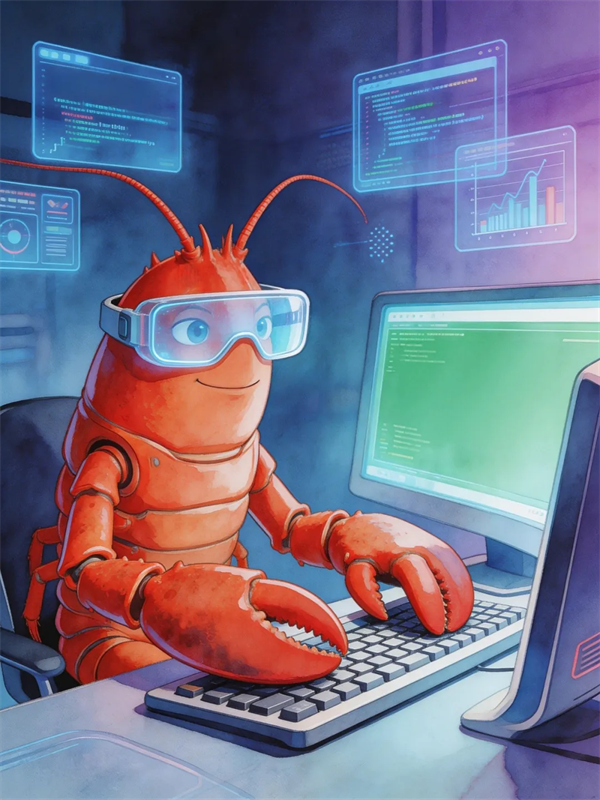
Image generated by AI
It is not a real lobster, but an open-source AI agent called OpenClaw. Literally translated as "open-source claw," it has earned the nickname "lobster" because its icon features a red lobster, symbolizing flexible and efficient task execution. On its official website, OpenClaw describes itself as "the AI that actually does things."
This "lobster" is rapidly making its way into developers' computers and entrepreneurs' offices, and has emerged as a widely discussed topic at this year's "Two Sessions".
The question is: How do you "raise" it? How do you use it? And how can you make it actually work—rather than just sit idle?
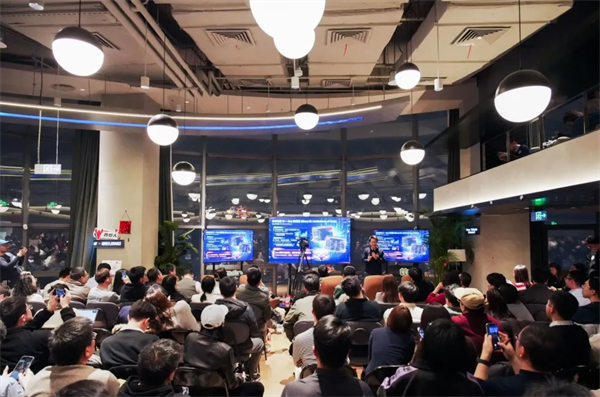
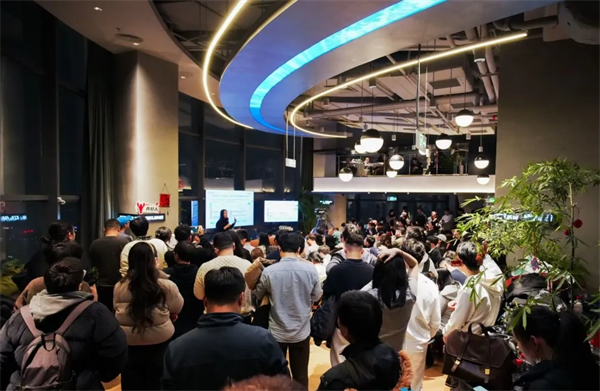
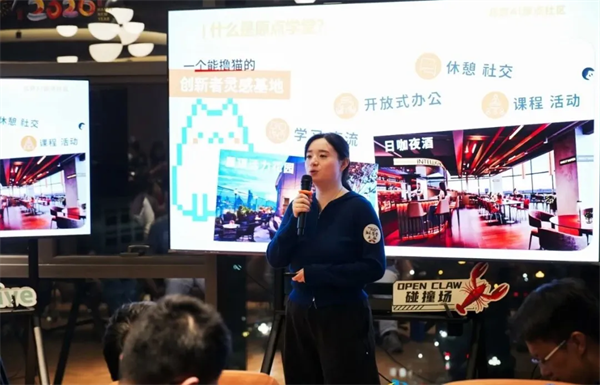
To explore practical ways of applying OpenClaw, "the OpenClaw Collision Forum" was recently held at Genesis Academy. The event was jointly launched by several organizations, including the Genesis Academy of Beijing AI Genesis Community, TTC Advisory, Zhongguancun Native Engine and the Beijing Artificial Intelligence Association. More than 300 AI entrepreneurs, investors, developers, and experienced OpenClaw users attended the gathering. They shared methods, technical solutions, and hands-on experience in "raising lobsters," while discussing the deeper logic behind the commercialization of AI agents.
Experts Share Their "Lobster-Raising" Playbook
Unlike large AI models, OpenClaw is an open-source AI agent capable of executing terminal commands, reading and writing files, sending and receiving emails, and managing schedules on behalf of users. All of this can be done through natural language interaction, without requiring users to understand programming or operating systems.
OpenClaw can even run locally on personal devices. Through a built-in "heartbeat mechanism," it checks tasks automatically every 30 minutes, functioning like a digital employee on standby 24 hours a day.
While the idea of putting the "lobster" to work is exciting, many are still asking how exactly to use it. At the forum, participants from organizations including Genesis Academy of Beijing AI Genesis Community, TTC Advisory, the Beijing Artificial Intelligence Association, Zhongguancun Native Engine, Naughty Labs Community, Baidu AI Cloud, the RTE Developer Community, Minimax, Edge Partners, Silicon Star,and 101AI engaged in intensive discussions on real business bottlenecks, cost calculations, and engineering practices.
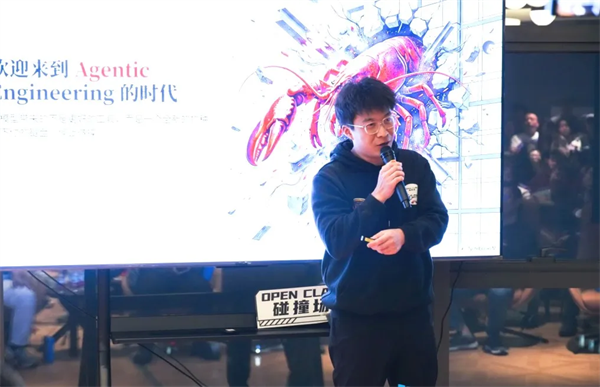
As a non-technical founder who does not write code, Yang Tianrun broke into the top 30 contributors for OpenClaw on Microsoft-owned GitHub in just 72 hours. Those ranked immediately before and after him are Silicon Valley engineers with over 10 years of professional experience. Yang is a representative of OPC (One-Person Company) from Genesis Academy and CEO of the Naughty Labs Community.
His unconventional journey highlights how OpenClaw lowers technical barriers. In front of a dialogue box, curiosity and the courage to experiment can matter more than programming skills. Based on this experience, Yang even declared that "Vibe Coding is dead." In his view, both traditional manual coding and early AI-assisted programming are becoming outdated. The future lies in "Agentic Engineering," where humans define goals and context while AI agents independently execute tasks with minimal intervention. "In the face of chat interfaces, the line between arts and sciences has been erased," Yang said.
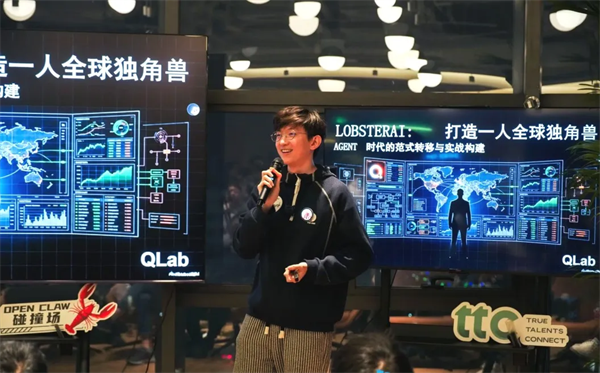
Several developers also showcased hardcore products built with OpenClaw. Gao Bo, founder of T-one Tech and a member of the Genesis Alumni Community, analyzed the full process of AI agent infrastructure from prototype to product from an engineering perspective. Meanwhile, AI creator "Frank" demonstrated the QLab accelerator, which has been fully integrated with OpenClaw.
"The OpenClaw Collision Forum" was much like cracking open a lobster: participants dug into real-world business scenarios, shared cutting-edge industry insights, and exchanged practical solutions. The discussions provided valuable references for advancing the commercialization of AI agents and promoting industry collaboration.
The "Lobster" Needs a Base; the Ecosystem Needs Soil.
As an open-source AI agent, OpenClaw has won wide popularity and begun to demonstrate commercial value, underscoring the immense potential of AI agents. Even the most capable AI cannot work without proper tools. To make this AI "lobster" perform, we must first equip it with the necessary tools.
Just as OpenClaw relies on technical support to function, the large-scale deployment of AI requires a strong technological foundation. Addressing widespread concerns about AI complexity, Lin Xiaolin, operations head of Baidu AI Cloud's Qianfan Platform, outlined a practical roadmap for AI deployment. She explained how AI systems evolve from handling complex tasks to coordinating multiple agents. One real case showed how 32 AI agents were used to build a complete private-domain business loop for a client. Lin also highlighted the concept of the "one-person company," offering individuals a viable path to commercializing AI applications.
Meanwhile, Li Zhichao, Vice President of TTC, summarized three practical takeaways from experience serving over 1,500 AI-native enterprises: Clearly define agent personas and tool boundaries;
Maintain cost-effective investment in computing power; Build an AI agent economy where B-side clients post tasks and C-side users accept them. TTC CTO Ning Liaoyuan further reviewed practices involving more than 900 AI agents, emphasizing principles such as "avoiding function bloat" and "nurturing agents properly" to help enterprises avoid pitfalls.
From a top-level design perspective, Ma Jianping, head of the AI Task Force at ZGC Group, shared Beijing's investment layout and ecosystem planning in the AI sector, highlighting policy advantages for entrepreneurs.
Wang Yu, representative of the organizers at Genesis Academy, shared the academy's ecosystem philosophy: "application implementation, resource exchange, and co-creation of business opportunities." Centered on its core 3S Cycle—Study, Social, and Sale—the academy fosters the deep integration of innovative elements in the AI sector. "We offer hands-on training for college students to kick-start their careers, support corporate growth and resource matching, and help startup teams launch their products and implement technologies. We bridge dreams and opportunities, empowering every innovator to enhance their capabilities, incubate projects, and share resources, as we jointly embrace the future of artificial intelligence."
The AI Genesis Community in Haidian, spanning about three square kilometers, has already attracted more than 300 AI companies. In 2025 alone, the area recorded over 2,000 AI-related patents and trademarks. With an industrial concentration of 73.99 percent, the community has formed a collaborative ecosystem where upstream and downstream partners can be found in the same building.
During the 15th Five-Year Plan period, Haidian District will foster an AI innovation ecosystem featuring the "Two Communities and One Belt" strategy. From policy advantages and investment layouts to open-source communities and incubation platforms, a comprehensive industrial ecosystem for AI agents is taking shape.
Security Comes First
While "raising lobsters" unlocks all kinds of possibilities, safety is the prerequisite. Poor practices can lead to risks that must not be underestimated.
According to the National Vulnerability DataBase (NVDB) under China's Ministry of Industry and Information Technology, some OpenClaw deployments may pose security risks when default or improper configurations are used, such as cyberattacks and data leaks.
OpenClaw—formerly known as Clawdbot and Moltbot—is an open-source AI agent that integrates multi-channel communication with large language models. It can function as a customizable AI assistant with persistent memory and proactive execution capabilities and can be deployed locally in private environments. Due to its "blurred trust boundaries" during deployment, coupled with its capabilities for continuous autonomous operation, independent decision-making, and access to system and external resources, OpenClaw can create vulnerabilities if not properly managed. Without effective permission control, auditing mechanisms, and security hardening, risks such as unauthorized operations may arise, triggered by instruction manipulation, configuration flaws, or malicious takeover, which can lead to data leakage, system compromise, and other serious consequences.
In its alert, NVDB advised relevant organizations and users to fully check their public network exposure, permission settings, and credential management when deploying and using OpenClaw. They recommended closing unnecessary public network access, strengthening security mechanisms including identity authentication, access control, data encryption, and security auditing, and staying updated on official security announcements and hardening recommendations to prevent potential cybersecurity risks.
Artificial intelligence is a double-edged sword—and the AI "lobster" is no exception. Raising "lobsters" is a technical endeavor; you cannot simply leave them unattended. To make the AI "lobster" a reliable assistant, no effort can be spared in its proper development and management. Only when well-maintained will the "claws" of the "lobster" serve us effectively.
From "watching AI" to "using AI," and from "being defined by tools" to "defining tools"—this craze for the "lobster" is essentially an experiment in redefining the relationship between humans and agents.
Learning to be friends with the AI "lobster" may well be the new compulsory lesson of our era.