At this year's Spring Festival Gala (Year of the Horse), the robot Galbot impressed the audience with its wide range of abilities. From handling walnuts and picking up broken glass to retrieving items from shelves, folding clothes, and even skewering sausages, it carried out a variety of everyday tasks with remarkable ease.
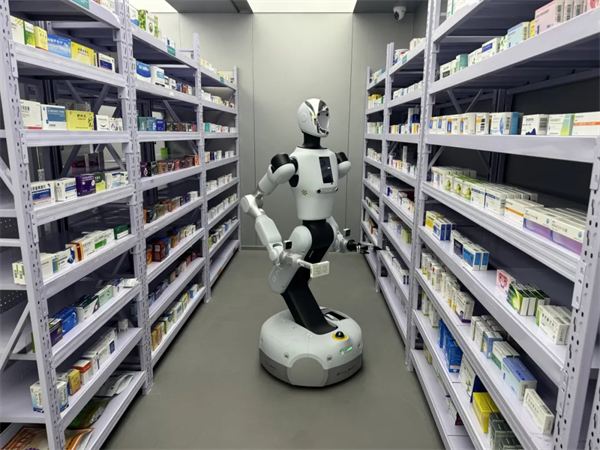
Recently, at a pharmacy in Haidian District, Galbot has transformed into a store assistant. It can quickly locate medicines on shelves, pick them up with its robotic arm, and steadily hand them over to customers.
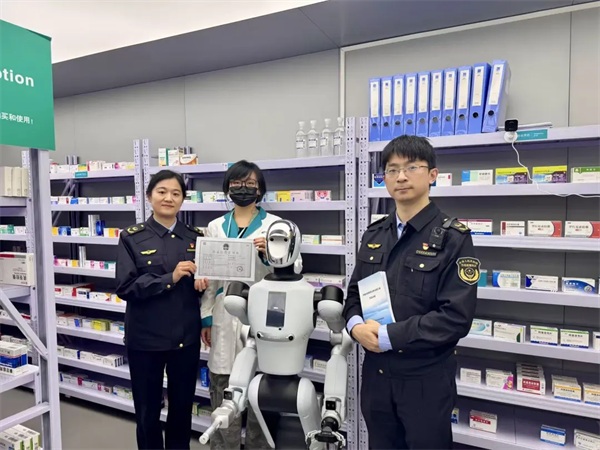
It is known that robots serving as pharmacy sales assistants require the enterprise to hold a Medicinal Product Distribution Permit. Recently, the Haidian District Administration for Market Regulation issued a Medicinal Product Distribution Permit. to the Danling Street Branch of Beijing Nepstar Chainstore Co., Ltd., marking the official rollout of embodied intelligent robots in Beijing's pharmacy retail sector. The intelligent retail pharmacy robot, developed by Beijing Galbot Co., Ltd. (hereinafter referred to as "Galbot"), is further expanding the application scenarios of embodied intelligence technology.
From the outset, Galbot was designed to support full-range retail needs, covering pharmaceuticals, medical devices, and pre-packaged foods and other products. It can efficiently perform full-process automated operations including pharmaceutical inventory checks, intelligent restocking, precise pickup and delivery, and standardized packaging, adapting to the dynamic operational needs of retail scenarios. Meanwhile, it has taken the lead in achieving generalized grasping capability for medicines packaged in any material - including fragile, irregularly shaped, and sealed packages - ensuring safety and accuracy during medicine handling.
In practical application, Galbot can provide 24-hour uninterrupted pharmacy services in a standard 70-square-meter pharmacy. Thanks to its three-dimensional storage structure and optimized intelligent cargo lane design, the robotic system has achieved a remarkable breakthrough in space utilization. A 70-square-meter store can display up to 5,000 pharmaceutical SKUs (stock keeping units), greatly improving space efficiency compared with traditional retail layouts and saving valuable space for pharmacy operations.
"The robot can independently perform full-process automated operations including order receiving, sorting, packaging, restocking and inventory checking. It takes only one to two minutes to sort an entire instant retail order, with a daily peak processing capacity of 370 orders. The system can replace repetitive tasks in traditional pharmacies such as inventory checking, restocking and order sorting, reducing labor input per store by more than 50%. It effectively frees up professional technicians such as licensed pharmacists from manual work, allowing them to focus on core professional services including prescription review and medication guidance, so as to improve the quality and efficiency of pharmaceutical services," introduced Chen Jiang, General Manager of Beijing Nepstar Chainstore Co., Ltd.
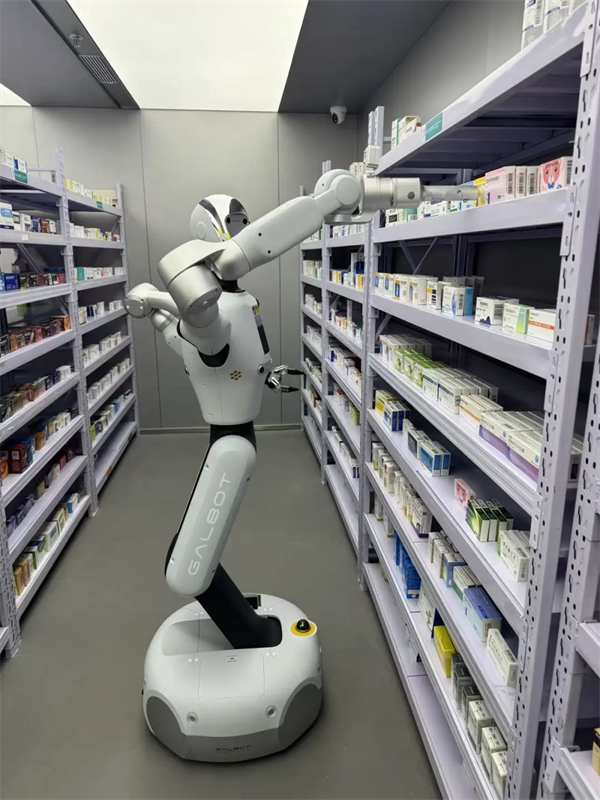
It is reported that Galaxy General Robotics has developed a robot-enabled pharmacy sales system for Galbot, integrating high-precision AI vision and traceability code collection technologies. The system enables full life cycle data recording for pharmaceuticals, realizing "traceable sources and trackable destinations". Galbot also features a built-in expiration warning algorithm that can automatically identify drugs approaching their shelf life and lock them for removal from shelves. By prioritizing the sale of near-expiry products, it optimizes inventory turnover and technically eliminates the risk of selling expired medicines.
In December 2025, Beijing issued the Beijing Action Plan for Supporting the Development and Application of Artificial Intelligence in the Healthcare Sector (2026–2027), which encourages AI to empower primary-level pharmaceutical scenarios and supports the deployment of intelligent medical terminals in communities, industrial parks and other settings. To ensure safety following the launch of the innovative robot-assisted pharmacy service, the Haidian District Administration for Market Regulation has established a service mechanism featuring "early intervention, whole-process guidance, and precise regulation". From preliminary design revisions to on-site inspections, the authority has guided enterprises in optimizing spatial layout and operation plans in line with the characteristics of robots, and clarified the scope of over-the-counter (OTC) drug sales and data security standards. In addition, the system has been connected to Beijing's drug traceability platform to achieve full-process traceability under the "one drug, one code" system, forming a development model of "technological innovation + compliance and control".
A relevant official from the Medical Device and Drug Circulation Division of the Haidian District Administration for Market Regulation said that as the first pilot area in China for the large-scale application of embodied intelligent robots in pharmaceutical sales, Haidian will continue to unlock the policy dividends of the "AI +" initiative. The district will encourage enterprises to explore more innovative scenarios in the medical and health sector. Through technological iteration and model innovation, smart services will benefit more people, injecting Haidian's momentum into the construction of a "Healthy Beijing".
A robot pushes open a door.
From the spotlight of the Spring Festival Gala stage to the counter of a pharmacy in Haidian, Galbot has made an extraordinary transformation - becoming China's first certified robot pharmacy assistant.
This seemingly effortless leap embodies a profound shift as embodied intelligence moves from "stunt performances" to "real-world applications". When its delicate robotic arm steadily hands over a box of medicine, it delivers not just what people need, but also a key to unlocking the future of smart healthcare.
In the eyes of many, robot-assisted pharmacy sales may seem like nothing more than an intelligent upgrade of vending machines. However, the deployment of Galbot in pharmaceutical retail scenarios is actually a systematic reshaping of the traditional pharmaceutical retail model. 24-hour uninterrupted operation and a daily peak processing capacity of 370 orders —behind these figures lies a "boiling hot" efficiency revolution. It enables a 70-square-meter space to accommodate 5,000 pharmaceutical SKUs, achieving a leap in space utilization. What's more, it completely frees up licensed pharmacists and clerks from repetitive manual tasks such as locating and retrieving medicines, allowing them to return to their professional essence —focusing on professional services including prescription review, medication guidance, and humanistic care. This is not merely a simple replacement of human labor, but also a restructuring of medical resources and the paradigm of productivity.
The value of technology ultimately lies in people's sense of gain. The application of Galbot in the important people's livelihood field of medical and pharmaceutical services precisely addresses a long-standing pain point related to people's well-being. Currently, the proportion of 24-hour pharmacies across the country remains relatively low, while the demand for medication at night is rising at a relatively rapid rate, with the supply-demand contradiction becoming particularly prominent late at night. When a child has a sudden high fever or an elderly person is in urgent need of medicine at three o'clock in the morning, what Galbot provides is not just a box of medicine, but also a sense of soothing in the late night. The seemingly simple shift from "people waiting for medicine" to "medicine waiting for people" reflects how technology can truly serve people's needs.
Moreover, Galbot has built a solid technological barrier for drug safety. Equipped with the "one drug, one code" traceability system and expiration warning algorithm, it provides an intelligent guarantee for the "last mile" of drug circulation. The high-precision visual recognition system can accurately collect the traceability code of each box of medicine, making the flow of medicine fully traceable and verifiable; the intelligent algorithm automatically identifies drugs approaching expiration and follows the principle of "first-out for near-expiry drugs", blocking the possibility of circulation of "returned drugs" and "expired drugs" from the source.
From "palming walnuts" to "grabbing medicines", from "performance stages" to "application scenarios", every transformation of Galbot is knocking on a new door to the industry — and beyond that door lies a vast world where embodied intelligence is deeply integrated with thousands of industries.
Its cross-scenario development reveals the essential logic of AI industrialization: only when technology is immersed in the hustle and bustle of daily life can it be transformed into real productivity. As its research and development team put it: "Seamlessly connect the innovation chain with the industrial chain, and let robots truly enter thousands of households." The profound meaning of this sentence is that the end of innovation is never the exhibition platform in the laboratory, but the life scenarios on every street and alley, the places within easy reach of ordinary people.
As more Galbots enter community pharmacies and become part of everyday neighborhood life, becoming the "health guardians" around ordinary people, the benefits of technology can truly people where it matters most.. This is not only the progress of the robot industry, but also a vivid example to how smart healthcare benefits people's livelihood.