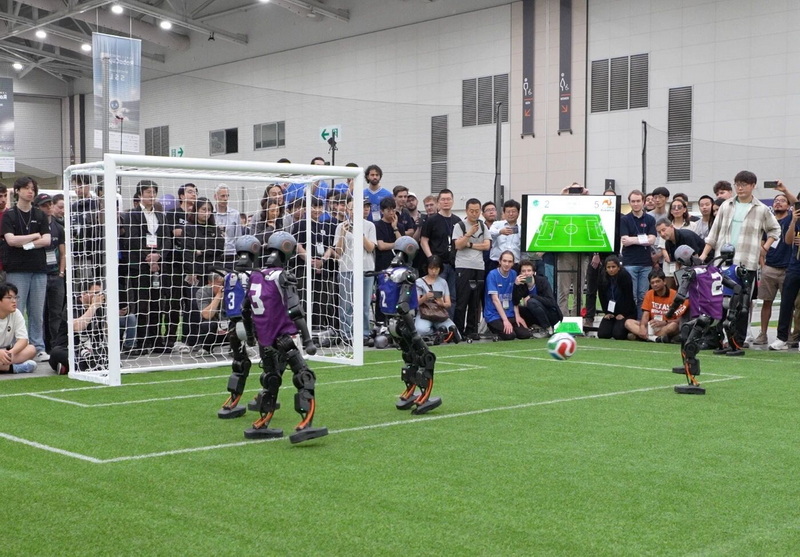
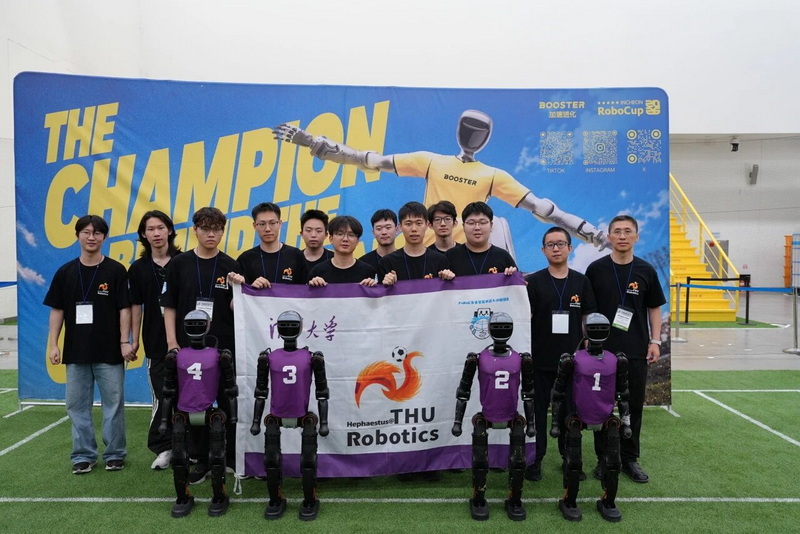
Photo: Courtesy of Booster Robotics
Remember the robot soccer team that ended 28 years of foreign champion monopoly and achieved glorious results at last year’s RoboCup (Robot Soccer World Cup)? This year, they traveled to Incheon, South Korea, and lifted the championship trophy high once again, letting China’s sci-tech prowess shine brightly on the world stage.
On July 5, the 2026 RoboCup concluded in Incheon, South Korea. In the highly anticipated humanoid robot category, Chinese team THU Huoshen Team, equipped with core robots provided by Beijing Booster Robotics Technology Co., Ltd. (hereinafter referred to as “Booster Robotics”), a Haidian-based enterprise, successfully defended the world championship title in the humanoid division. In addition, a total of 38 teams in this year’s competition used Booster Robotics’ robots as their competition platforms, with winning teams sweeping all gold medals across all bipedal humanoid categories.
Constantly Pushing Technical Limits on the Green Field
Founded in 1997, RoboCup is one of the world’s largest robotics and artificial intelligence competitions, and has been continuously evolving around a long-term vision — to cultivate a fully autonomous robot soccer team capable of defeating the human World Cup champions before 2050. While the soccer rules are similar, the boundaries of capability tested are different: the World Cup challenges human physical fitness, willpower and creativity; RoboCup, meanwhile, constantly pushes the technical limits of robots in perception, locomotion and intelligent decision-making.
It is reported that among the numerous testing scenarios for humanoid robots, soccer has long been recognized as the “touchstone” for dynamic performance. It simultaneously tests three core capabilities: real-time perception, stable locomotion control, and multi-agent collaborative decision-making, covering the complete technical chain from robot perception to execution—a whole “blitzkrieg” of “visual acquisition—target recognition—trajectory planning—joint execution”, where latency must be compressed to the millisecond level. At the same time, it must complete running, shooting and physical confrontation under multiple constraints of power, self-weight and endurance, representing the ultimate validation of hardware performance.
For this very reason, soccer has long been regarded as a concentrated proving ground for humanoid robot technical capabilities—whoever can achieve stable confrontation on the field is more likely to be the first to break through the boundaries of real-world application deployment. For nearly three decades, this validation has been continuously staged on the RoboCup platform.
In this competition, THU Huoshen Team’s successful title defense signifies not merely a championship repeat, but that the entire technical system has withstood the ultimate test of repeated study and targeted challenge by top global opponents. To meet the demands of this competition, THU Huoshen Team completed critical upgrades in strategies such as multi-agent coordination and dynamic target tracking.
“The fact that THU Huoshen Team has once again reached the summit in the face of targeted challenges from top global powerhouses powerfully demonstrates its leading position in the field of embodied intelligence algorithms”, a responsible official from Booster Robotics told the reporter.
From “Building the Body” to “Training the Brain”
The most industry-shaking event at this year’s RoboCup was not a single team’s championship victory, but rather that an increasing number of teams from different countries and with different technical approaches stood on the podium thanks to the same robot model.
It is reported that a total of 38 teams in this competition used Booster Robotics’ robots as their competition platforms. In addition to THU Huoshen Team defending the Large division championship with BoosterT1, B-Human won the Middle division championship equipped with BoosterK1; Wuhan University Invic Robot Team clinched the Small division championship with BoosterK1Air, with Booster Robotics robots sweeping all gold medals across all bipedal humanoid categories. Furthermore, multiple international traditional powerhouses including HTWK from Germany and UT Austin from the United States all selected Booster Robotics robots and stood on the podiums of their respective divisions.
According to reports, for nearly three decades, every team on the robot soccer World Cup stage had to build robots from scratch—designing mechanical structures, debugging hardware, and writing basic locomotion programs, with vast amounts of energy consumed on body manufacturing. But this year, the picture changed. Participating teams began focusing all their attention on “higher-level” capability breakthroughs: how to make robots see more accurately, think faster, and coordinate more seamlessly with teammates. Meanwhile, Booster Robotics robots played the role of a “behind-the-scenes platform”, continuously honing the “leg and foot skills” of the robot body—high-speed running, emergency stopping and turning, and getting back up after falling.
More profoundly, the maturation of underlying hardware and development tools is lowering the entry barrier for embodied intelligence innovation. According to a responsible official from Booster Robotics, one of the youngest participating teams in this year’s humanoid division appeared on the field: Pui Ching Middle School Team from Macao, China. “From world-class universities and top-tier laboratories to a broader community of ordinary developers and middle school teams, an open and shared embodied intelligence R&D ecosystem is taking shape at an accelerated pace”, said the responsible official from Booster Robotics.
Booster Robotics BoosterT2 Set for Imminent Release
THU Huoshen Team’s successful title defense demonstrates China’s leading strength in the field of embodied intelligence algorithms. Meanwhile, the phenomenon of “large-scale deployment” across 38 teams and all three divisions sweeping gold medals conveys a signal of greater industry vanguard significance: the “platformization consensus” for underlying hardware in global embodied intelligence is accelerating its formation.
“Soccer is merely the form of extreme stress testing; what is truly being tested is the robot’s comprehensive survival capability in the face of the real world. Among these, leg and locomotion control is the physical foundation upon which all higher-level intelligence can be exercised”, said the responsible official. Only when robots can stably withstand gravity and friction does intelligent decision-making acquire practical significance. The chaos and uncertainty that robots learn to cope with on the field today are precisely the technical cornerstone for their entry into real-world scenarios tomorrow.
As the “champion behind the champions”, Booster Robotics is demonstrating to the world its strategic value as embodied intelligence infrastructure. By continuously refining robot bodies, leg and locomotion control capabilities, and the BoosterStudio development toolkit, Booster Robotics is committed to enabling outstanding research teams and developers worldwide to bridge the physical divide, jointly accelerating the arrival of the Great Navigation Era of embodied intelligence, and continuously injecting momentum into China’s construction as a world leader in science and technology.