AI for Science (AI4S) is becoming a key force in accelerating scientific discovery and innovation breakthroughs, and supporting high-level sci-tech self-reliance and strength. As AI4S formally moves from “concept exploration and model trials” into a new development stage of infrastructure formation and vertical scenario landing, we are witnessing a profound transformation of the scientific research paradigm.
In Haidian, the transformation unleashed by AI4S is creating one miracle after another: from the birth of China's first general scientific foundation large model “ScienceOne, ” to the landing of the world's first full-process scientific talent cultivation intelligent agent system Omni Scientist; from the multiple-fold shortening of materials R&D cycles, to the significant reduction of drug R&D costs.. . A scientific research paradigm revolution deeply driven by AI is advancing from blueprint to reality, and from vision to action.
Leveraging Unique Advantages, Haidian Leads the AI4S Era Direction
As the national AI innovation source, Haidian takes the lead in piloting the AI4S new paradigm. It gathers top-tier intelligence and high-end computing power, continuously nurturing scientific momentum that will change humanity's future. With three core advantages of “densest resources, most solid foundation, and strongest models, ” Haidian vigorously competes in the AI4S new track, proactively leading industry development trends.
This Is an “Innovation Ecological Rainforest” Where Top-Tier Resources Cluster
If AI4S is likened to a towering tree, then innovation resources are the fertile soil nourishing it. In Haidian, the depth and density of this soil are unmatched nationwide.
Peking University, Tsinghua University, the Chinese Academy of Sciences, the Zhongguancun Academy, the Zhongguancun Artificial Intelligence Research Institute, the Al for Science Institute, BEIJING.. . Over 10 core AI4S institutions cluster and gather momentum here. Over 30 innovative enterprises including DP Technology and BioMap have assembled and grown here, jointly supporting two-thirds of Beijing's AI4S industrial landscape. From basic research and technology R&D to achievement transformation, a complete and vibrant innovation chain is seamlessly connected in Haidian with one click.
Someone has summarized a “wisdom density” formula for Haidian: Wisdom Density=(Number of Top Brains×Collision Randomness) ÷ Physical Distance Squared. It is precisely this high-density aggregation of innovation resources that makes the sparks of intellectual collision easier to ignite, and repeatedly shortens the distance from laboratory to market for innovation achievements.
Major Platforms Here Provide a “Super Runway” for AI for Science
If models are the “engine” of AI4S, then major platforms are the “super runway” carrying this engine's high-speed operation.
Looking across Haidian, one hardcore platform after another is accelerating its landing, becoming a key force driving AI4S forward.
The Al for Science Institute, BEIJING, in collaboration with DP Technology, has launched the Bohr Space Station, the first AI scientific research cloud platform covering “literature reading, computation, experimentation, and multi-disciplinary collaboration. ”
The Department of Chemistry of Tsinghua University empowers synthetic chemistry with AI, building an intelligent chemistry tool chain, using lightweight experiments to discover novel catalytic reactions, and accelerating the R&D of innovative drug and new material molecules.
The School of New Materials at Peking University focuses on intelligent breakthroughs in carbon-based materials, creating the CarbonKylin intelligent platform. Relying on AI, it completes material structure prediction, performance simulation and process optimization, successfully landing frontier technological achievements such as high-performance fibers and industrial-grade single-atom catalysts.
The University of Science and Technology Beijing leads the construction of the National New Materials Big Data Center, aggregating core data across all categories of materials, building a national-level data hub, and providing powerful data support for scientific research.
Caption: Interface of the Bohr (Bohrium) Scientific Research Space Station, jointly released by the Al for Science Institute, BEIJING and DP Technology
Here, Comprehensive Breakthroughs in Both “General Brain” and “Specialized Experts” Have Been Achieved
In Haidian, the development of AI4S models is like two teams advancing side by side: one is the “general brain, ” solidifying the foundation for all-domain science; the other is “specialized experts, ” courageously climbing peaks in vertical domains.
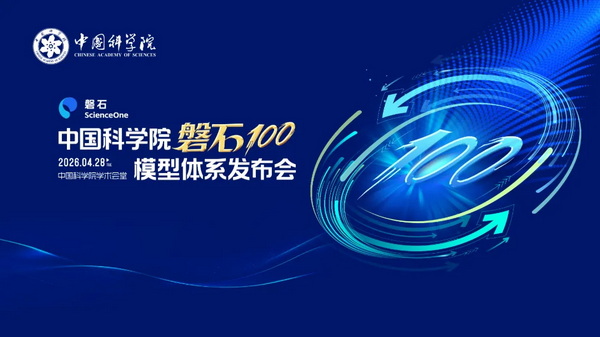
The Chinese Academy of Sciences, in collaboration with over 10 research institutes, released China's first general scientific foundation large model “ScienceOne” and the “ScienceOne 100” all-domain scientific model system, integrating a complete set of professional simulation tool chains, achieving cross-disciplinary collaborative reasoning and full-process autonomous scientific research closed loop.
Caption: Release of the Chinese Academy of Sciences ScienceOne 100 Model System
The MegaDFT model from the Zhongguancun two academies (institutes) achieves “hundred-thousand-atom-level” high-precision simulation, bringing first-principles calculations into the stage of real complex system research, supporting quantitative analysis of ultra-large biomolecules and non-periodic materials with quantum chemical precision.
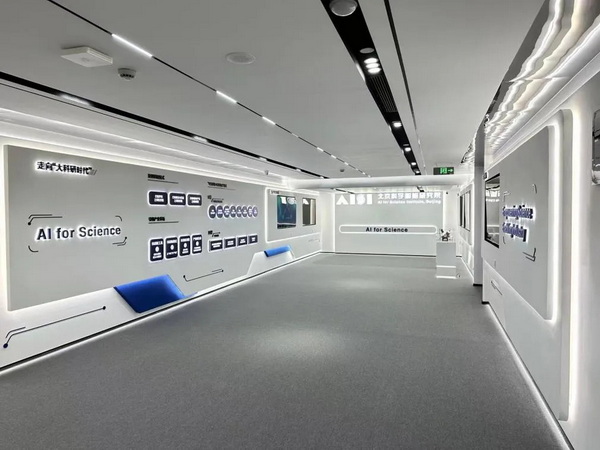
The Al for Science Institute, BEIJING launched the new-generation model architecture DPA4, topping the “Matbench Discovery” international authoritative benchmark in materials discovery, supporting the R&D innovation of new materials including batteries, catalysts, and semiconductors.
Caption: Exhibition area of the Al for Science Institute, BEIJING
The Beijing Institute for General Artificial Intelligence (BAAI) self-developed the OpenComplex 2.5 domestic integrated AI drug discovery model, innovating end-to-end full-atom distribution modeling, with a single model covering multiple core tasks in drug R&D.
Setting Application Benchmarks, Haidian Unleashes AI4S Industrial Momentum
No matter how outstanding model performance is, it must ultimately enter scenarios to undergo practical testing. In Haidian, AI4S has long jumped off the pages of papers and bid farewell to laboratory concepts. It is no longer a suspended frontier concept, but has transformed into a practical productivity tool that is deployable, reusable, and efficiency-enhancing, continuously taking root in key tracks such as biomedicine, advanced materials, and high-end manufacturing.
AI+New Materials: From “Empirical Trial-and-Error” to “Simulation Prediction”
In the past, new materials R&D was long trapped in a “cooking-style” trial-and-error mode, universally plagued by pain points such as long experimental cycles and high R&D costs. Currently, Haidian District is seizing the AI4S development opportunity, relying on general-specialized integrated models to systematically reshape the full-chain new materials R&D system.
Haidian District is strategically deploying specialized incubation platforms to smooth the achievement transformation channel. The Pipo Incubator, located at the Jinyu Zhihui Center, focuses on the AI+new materials track, relying on top-tier university and research institute resources including Peking University, Tsinghua University, Beihang University, and the Chinese Academy of Sciences to build a four-dimensional empowerment system of technology, computing power, industry, and capital. The continuous aggregation of industry-university-research resources lays a solid foundation for enterprises to carry out technical breakthroughs and industrial scenario verification.
The Piloteye battery full-process automated design platform developed by DP Technology effectively shortens the battery materials R&D iteration cycle. The industrial intelligent agent product developed by Suyuan Matrix, in typical process industrial scenarios such as cement, has improved product qualification rates from 95% to 98%, reduced comprehensive cost per ton by 2%-3%, and achieved annualized cost savings exceeding RMB 10 million within half a year of production launch.
AI+New Drug R&D: From “Ten Years to Sharpen One Sword” to “Results in Two Years”
The new drug R&D industry faces a brutal “Rule of 30”: developing a new drug often requires a ten-year R&D cycle and one billion US dollars in investment, with an overall success rate of less than 10%, and R&D difficulty remains persistently high. Addressing the pain points and difficulties of the pharmaceutical industry, Haidian District closely follows the entire new drug R&D industrial chain, vigorously promoting the landing application of AI technology, with multiple platforms collaboratively building an industrial acceleration system.
Haidian District has linked with 24 industry-leading enterprises, relying on the Beijing Medical and Health Trusted Data Space to build the New Drug R&D 7S Acceleration Camp. The entire pharmaceutical R&D chain is deconstructed into 7 major segments and 30 key links, opening various AI tools and model resources to enterprises. At the same time, measures such as platform construction, data supply, and intelligent computing support reduce burdens and empower, aggregating quality AI tool resources and continuously accelerating the new drug R&D process.
Zhe Yuan Technology uses its “Human-Disease-Drug” platform to connect the entire R&D chain. Its pancreatic cancer targeted drug went from molecular design to IND (Investigational New Drug) approval in less than two years. Huashen Zhiyao leveraged an AI digital system to reduce pre-clinical candidate molecule development from 3-5 years to 10 months, gaining recognition from international pharmaceutical companies and rising to the forefront of global large-molecule drug R&D.
AI+Quantum Technology: From “Following” to “Leading”
Quantum bits are extremely fragile and highly susceptible to environmental noise interference causing computational errors. How to precisely capture atoms and perform real-time error correction has long been a world-class problem constraining the development of quantum computing.
Haidian District targets the full chain of quantum computing, promoting the deep integration of artificial intelligence and quantum technology, connecting basic theoretical methods with core device systems, and accelerating the R&D of high-reliability, scalable intelligent fault-tolerant quantum computing prototypes. Under the traction of the district's innovative layout, enterprises within the district, based on frontier scientific research resources, concentrate efforts to tackle key core technologies. For example, relying on Tsinghua University's ten-thousand-level autonomous atom capture technology, Quantum Intelligence has launched core achievements including the “Zhuifeng” ten-thousand-atom high-speed rearrangement algorithm and the “Bianque” AI quantum error correction decoder, laying a solid foundation for next-generation quantum intelligent computing.
Haidian District uses real application scenarios as traction, transforming AI4S from a concept in papers into a productivity tool in factories, hospitals, and laboratories. By building platforms, finding scenarios, and aggregating resources, it twists innovation elements into a single rope, driving the simultaneous transformation of AI4S into new quality productive forces in materials, medicine, and quantum fields.
Shouldering Mission and Responsibility, Haidian Builds an AI4S Innovation Highland
Relying on dual advantages in innovation and industry, Haidian District is leading industry trends with the posture of a “lead goose. ” From reconstructing underlying logic to consolidating foundational elements, and then to flourishing innovation ecosystems, a series of forward-looking explorations are making the “Haidian practice” of AI4S increasingly clear.
Reshaping the “Scientific Research Paradigm”: Giving Laboratories “Autonomous Capabilities”
If models are the “brain, ” then autonomous laboratories are the “hands and feet” for AI4S landing. Haidian District actively explores a new human-machine collaborative scientific research paradigm, targeting advantageous tracks such as innovative drugs, new materials, and synthetic biology, and deploying a batch of AI4S autonomous laboratory benchmark projects. It explores the construction, operation, diversified investment, and commercially sustainable closed-loop paths; simultaneously builds a standardized, replicable autonomous laboratory operation system, promotes the intelligent upgrading of traditional laboratories, and forms an innovation matrix with echelon layout and collaborative efforts.
Consolidating the “Data Foundation”: Building a Hundred-TB-Level “Resource Mine”
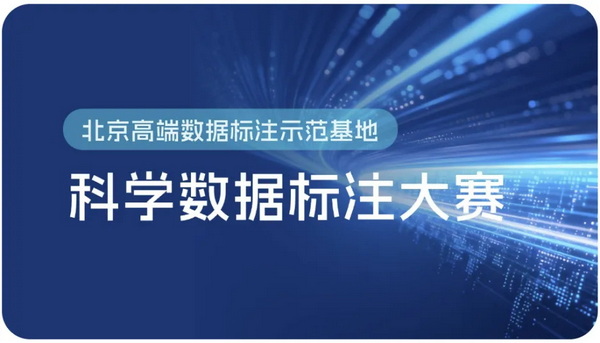
Data is the “fuel” for AI4S. Haidian District is committed to building China's first hundred-TB-level multi-source integrated scientific database system, constructing massive standardized high-quality scientific datasets, comprehensively connecting the automatic collection, governance, and application of experimental data, and fully empowering intelligent scientific research with high-quality data supply. Relying on the Beijing High-End Data Annotation Demonstration Base, it supports the hosting of scientific data annotation competitions, cultivating talent through competitions and gathering talent through competitions, nurturing a professional data annotation talent team, and forming an innovation closed loop of “algorithms empowering scenarios, scenarios feeding back technology. ”
Caption: Scientific Data Annotation Competition
Connecting the “Transformation Closed Loop”: Full-Chain Acceleration of Achievement Transformation
Achievement transformation is the “transmission shaft” connecting laboratories and production lines. Haidian District focuses on hot tracks such as scientific large models, AI+pharmaceuticals, AI+new materials, and AI+quantum, connecting the complete closed loop of “source innovation-achievement transformation-industrial aggregation, ” allowing frontier breakthroughs in laboratories to reach production lines and markets faster, and transforming into surging momentum driving industrial upgrading.
Cultivating “Innovation Fertile Soil”: Three-Dimensional Innovation Ecosystem Taking Shape
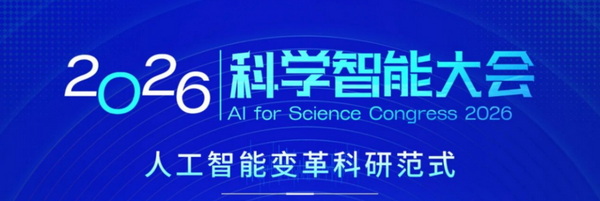
Haidian District is deploying and building AI4S specialized incubators, creating one-stop platforms integrating technology R&D and project incubation. It is planning the layout of AI4S industrial clusters, initiating the establishment of AI4S industrial funds, and landing high-level international scientific intelligence conferences, gathering quality talent, projects, and capital from around the world.
Caption: 2026 Conference on AI for Science
Here, it not only focuses on forward-looking basic research and strives to achieve transformative original breakthroughs, but is also becoming fertile soil for nurturing high-level theoretical talent and composite innovative forces, allowing innovation seeds to continuously take root, sprout, and grow vigorously, making Haidian a shining global innovation landmark.
Tang Chao, Deputy Director of the Zhongguancun Science City Management Committee and Vice District Mayor of Haidian District, stated that going forward, Haidian District will conduct forward-looking layout around transforming traditional scientific research paradigms, coordinate regional major scientific research and industrial forces, consolidate infrastructure construction, strengthen key technology breakthroughs, build an open-source and open ecosystem, and accelerate the construction of a scientific intelligence innovation source and industrial highland.