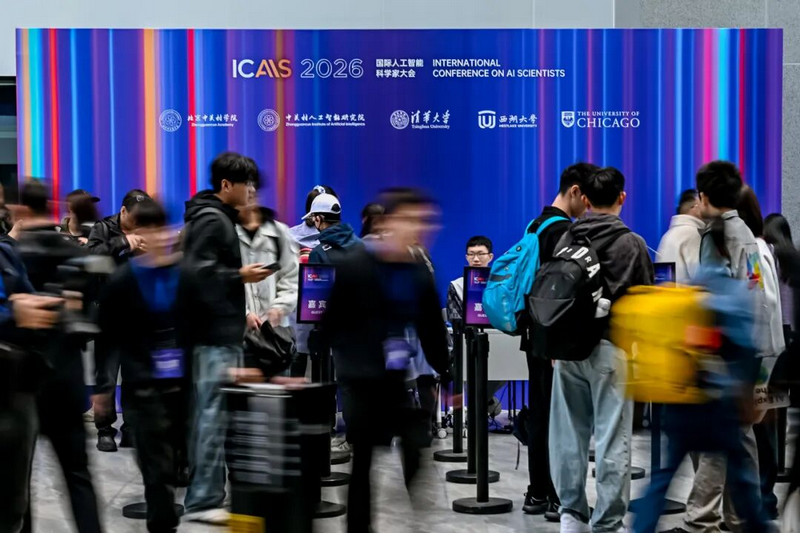
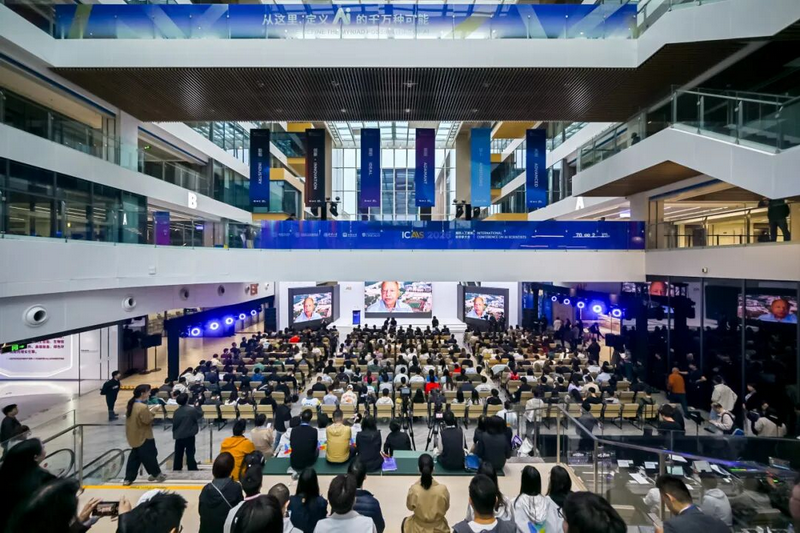
On October 17, the 2nd International Conference on AI Scientists (ICAIS 2026) officially opened in Haidian.
This year’s conference is guided by the Beijing Municipal Education Commission, Beijing Municipal Science and Technology Commission, and Beijing Talent Work Bureau. It is jointly hosted by Zhongguancun Academy, Zhongguancun Institute of Artificial Intelligence, Tsinghua University, and Westlake University, with the University of Chicago as a co-organizer. It is committed to building an international, high-level benchmark event for AI scientific research and a collaborative innovation platform, carrying forward the spirit of the Dartmouth Conference over the past 70 years, and analyzing the evolution trends and application prospects of artificial intelligence that may develop into general infrastructure.
ICAIS 2026 takes “Tracing the Original Aspiration of AI, Expanding the Boundaries of Scientific Exploration” as its theme, gathering multiple Nobel Prize and Turing Award laureates, Chinese and foreign academicians, global young scholars, and youth scientist representatives. It aims to trace the origins of artificial intelligence and let history provide enlightenment for the future; at the same time, it gathers global scientific research wisdom, explores new development paths for human-machine collaboration, and promotes the progress of artificial intelligence technology and the transformation of research paradigms.
Yu Yingjie, Member of the Standing Committee of the CPC Beijing Municipal Committee and Secretary of the Municipal Education Work Committee, and Su Jing, Director-General of the Fourth Department of the Ministry of Science and Technology, attended the conference and delivered speeches. Responsible officials from the Ministry of Education, Ministry of Science and Technology, China Association for Science and Technology, Beijing Municipal Education Commission, Beijing Municipal Science and Technology Commission, Zhongguancun Administrative Committee, Beijing Talent Work Bureau, and Haidian District attended the opening ceremony. Representatives from co-hosting universities and the Beijing Youth AI Academy (Haidian) participated. Liu Tieyan, President of Zhongguancun Academy and Chairman of Zhongguancun Institute of Artificial Intelligence, served as Conference Chair of this year’s conference and delivered the opening welcome speech.
On the first day of the conference, 2013 Nobel Prize in Chemistry laureate Michael Levitt, 1994 Turing Award recipient Raj Reddy, 2021 Turing Award recipient Jack Dongarra, brain-computer interface research pioneer Miguel Nicolelis, foreign academician of the Chinese Academy of Engineering Shen Zuojun, academician of the Chinese Academy of Sciences Liu Yunhao, and University of Chicago sociology professor James Evans delivered keynote speeches. Ma Xiao, professor at the University of Science and Technology of China; Angelica Aviles-Rivero, assistant professor at the Yau Mathematical Sciences Center, Tsinghua University; You Yang, founder of Colossal-AI; and Fan Hao, senior researcher at the Capital Institute of Medical Sciences Innovation Center, delivered invited reports.
In his opening address, Liu Tieyan pointed out that looking back at the seventy-year evolution of artificial intelligence since the Dartmouth Conference, the development of AI requires not only iterating new algorithms and new technologies, but also urgently building new research paradigms and human-machine collaboration models, achieving two-way empowerment between human wisdom and artificial intelligence. He stated that ICAIS 2026 will launch three “core action plans”: initiating the establishment of a Joint Research Center for Major Human Problems, relying on artificial intelligence technology to tackle major global scientific issues; helping young talents enter the scientific exploration track earlier, building a high-end exchange platform for new-generation research forces to engage in direct dialogue with Nobel and Turing Award laureates; and creating an international AI scientist community, building a cross-border, open and shared scientist collaboration network.
Zhongguancun Academy and Zhongguancun Institute of Artificial Intelligence will continue to explore new paradigms for scientific research and talent cultivation in the AI era. Liu Tieyan called out: “When human curiosity and creativity are mutually stimulated and empowered by AI’s generation and reasoning capabilities, we not only have the prospect of expanding the boundaries of scientific discovery, but will also build new collaboration networks and innovation ecosystems, jointly creating a more fabulous future. ”
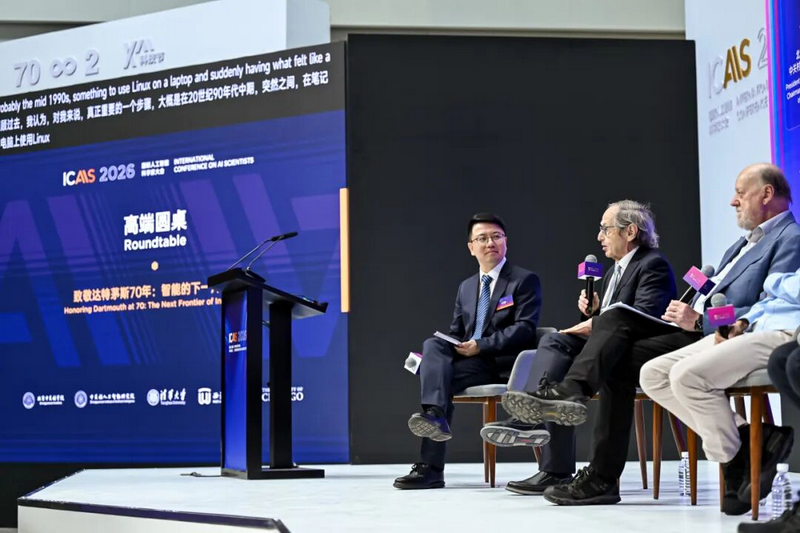
This roundtable forum takes “Honoring Dartmouth at 70: The Next Frontier of Intelligence” as its theme, hosted by Liu Tieyan, President of Zhongguancun Academy. Guests include Nobel Prize in Chemistry laureate Michael Levitt, Turing Award recipient Jack Dongarra, Professor Ma Xiao of the University of Science and Technology of China, and He Jiyan, Mentor at Zhongguancun Academy, among other top domestic and international scholars and young scientists. The forum reviewed the AI evolution journey initiated by the Dartmouth Conference, jointly exploring what research directions should be upheld in the face of the burgeoning future of artificial intelligence, and what benchmarks should be used to measure the true scientific value of artificial intelligence.
The forum opened with an ingenious “AI Museum”, where scholars selected symbolic research fragments from their own scientific careers, using individual research memories to connect the seventy-year development thread of artificial intelligence. Participating guests explored layer by layer the balance between the convergence of technical paradigms and diverse exploration, the revelations behind cyclical fluctuations in the field, and the openness and reproducibility of scientific research work. They also analyzed the deep relationships between intelligent prediction and mechanistic interpretation, and between theoretical deduction and empirical experimentation. The forum specially featured a “generational reversal dialogue”, where young researchers posed sincere questions of the era to their academic predecessors, recreating the pioneering and exploratory spirit of the youth at the Dartmouth Conference.
The most ceremonial design of this roundtable was the “2036 Time Capsule”: scholars, based on their own research fields, wrote down scientific predictions that could be empirically tested, clearly labeling the evaluation criteria and real-world constraints of the results. The relevant records were archived on-site, to be reviewed and revisited at the eightieth anniversary of the Dartmouth Conference. The entire dialogue carried forward the scientific inquiries of predecessors, adhering to the scientific spirit of falsifiability and emphasis on empirical evidence, jointly exploring the new boundaries of intelligent evolution.
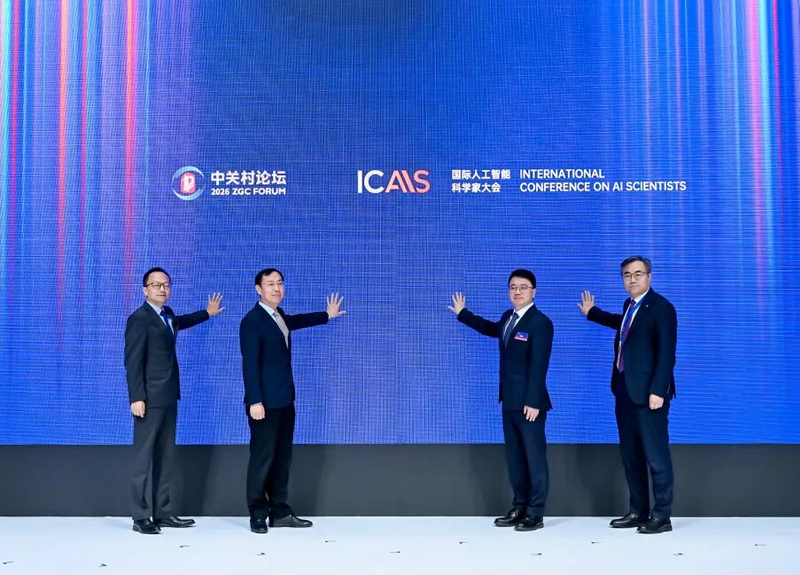
An important release ceremony was held at the conference: the 2026 Zhongguancun Forum Series Activities — International Conference on AI Scientists (ICAIS 2026); and the launch and creation of the International AI Scientist Community.
Zhongguancun Forum Series Activities are normalized series of events held throughout the year outside the annual meeting period of the Zhongguancun Forum. As one of the 2026 Zhongguancun Forum Series Activities, ICAIS 2026 is formally integrated into the matrix of national-level sci-tech innovation exchange and cooperation platforms. Going forward, the conference will rely on the global influence and resource advantages of the Zhongguancun Forum, continuously gather top global intelligence, deepen open scientific cooperation, build up reserves of future innovative talent, and jointly explore the new boundaries of AI-driven scientific discovery.
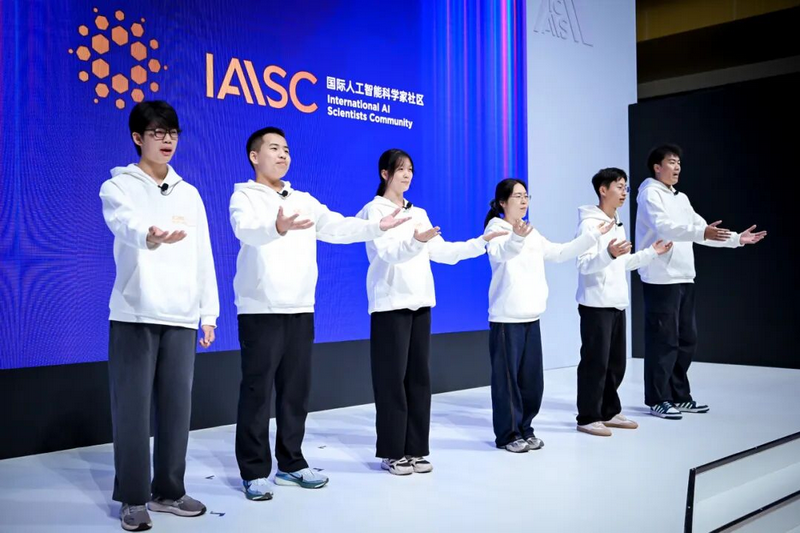
The International AI Scientist Community is initiated by AI-native youth scientific research representatives. Against the critical backdrop of the 70th anniversary of Dartmouth, it builds an open collaboration network connecting scientific exploration, youth growth, industrial practice, and global exchange, joining hands with global AI scientists, industry leaders, and young researchers to jointly expand the scientific frontier and co-create an intelligent future.
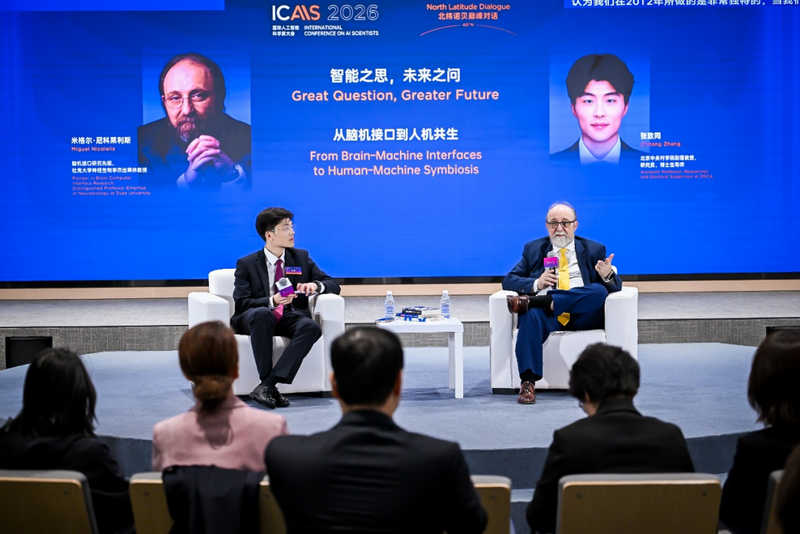
During the conference, multiple “North Latitude Dialogue” sessions themed “Great Question, Greater Future” will also be held.
The first dialogue focuses on the frontier proposition of “From Brain-Computer Interface to Human-Machine Symbiosis”, specially inviting Miguel Nicolelis, Distinguished Professor Emeritus of Neurobiology at Duke University, pioneer of brain-computer interface research, and academician of the French Academy of Sciences, to engage in face-to-face exchanges with attending guests and students of Zhongguancun Academy and Zhongguancun Institute of Artificial Intelligence, exploring brain signal-controlled machines, new cognition of perception and learning, the relationship between humans and technology, and the enlightenment that brain-computer interfaces bring to AI and human-machine collaboration. This event is hosted by Zhang Zhitong, Assistant Professor, Researcher, and Doctoral Supervisor at Zhongguancun Academy.
The “North Latitude Dialogue” originated from the intellectual inspiration of the International Conference on AI Scientists (ICAIS 2025), positioned as a “world-class feast of technological thought” and a “normalized cross-border exchange platform”, aiming to explore the infinite possibilities of artificial intelligence+scientific discovery, bringing together Nobel laureates and other top global scholars with scientists, entrepreneurs, and young talents rooted in Zhongguancun and contributing to Beijing, for in-depth dialogue and long-term connection.
The paper session is hosted by Li Qiuyi, Researcher at Zhongguancun Academy and Zhongguancun Institute of Artificial Intelligence, and Zhen Yuanyi, Assistant Professor at the AI+Humanities and Sociology Department of Zhongguancun Academy. Based on the two tracks of Science Journal Track and AI Paper Track, paper achievement sharing is conducted.
From October 17 to 19, 2026, the three-day 2nd International Conference on AI Scientists (ICAIS 2026) will continue to gather diverse global wisdom, presenting multiple high-level academic feasts. The conference will carry forward the scientific inquiry of Dartmouth, exploring new paths for the integration and symbiosis of carbon-based intelligence and silicon-based intelligence, unlocking the infinite possibilities of original scientific research innovation, and injecting new inspiration and momentum into the open and collaborative development of global artificial intelligence.
Source: Beijing Zhongguancun Academy