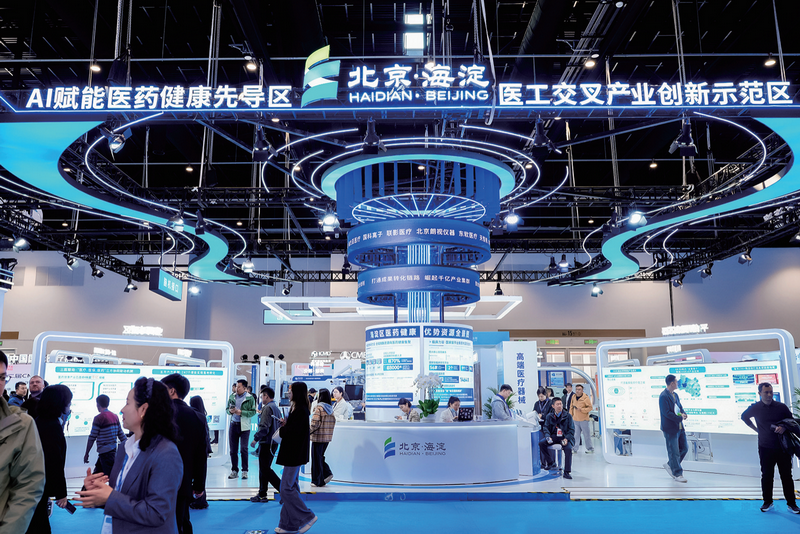
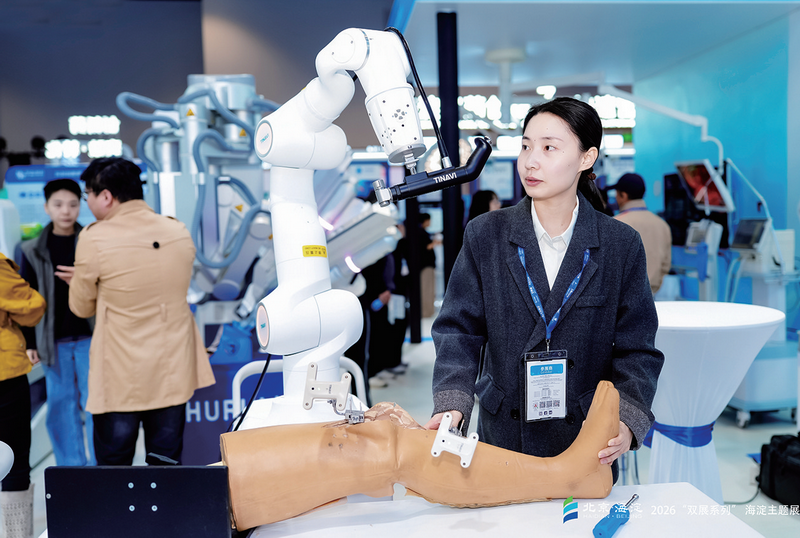
From October 21 to 24, at the 94th China International Medical Equipment Fair (CMEF), the Haidian thematic exhibition area made its debut in Hall A4. Centered on four major tracks — AI+Pharmaceutical and Health, Innovative Drugs, High-End Medical Equipment, and Brain-Computer Interface — it centrally presented representative enterprises and products, systematically showcasing Haidian’s pathways and achievements in the industrialization of medical-engineering cross-integration and AI-empowered high-quality development of pharmaceutical and health.
Four Major Tracks, Frontier Achievements Step to the Forefront
The Haidian exhibition area, covering only 378 square meters, directly confronts the challenges of pharmaceutical and health achievement transformation. Currently, the disconnect between scientific research and clinical practice, and between technology and industry, is widespread; in the new stage of AI empowerment, new difficulties such as restricted data usage, insufficient tool matching, and high computing costs emerge one after another. Haidian seeks breakthrough paths through its layout across four major tracks.
Entering the AI+Pharmaceutical and Health section, the reporter saw that the “Smart Pharma Innovation 7S Accelerator Camp” project fully covers seven major sections and 25 sub-links from model R&D to clinical application, and is accompanied by “Smart Drug Navigation Innovation Vouchers”, allowing small and medium innovation teams to afford platforms and dare to engage in frontier R&D.
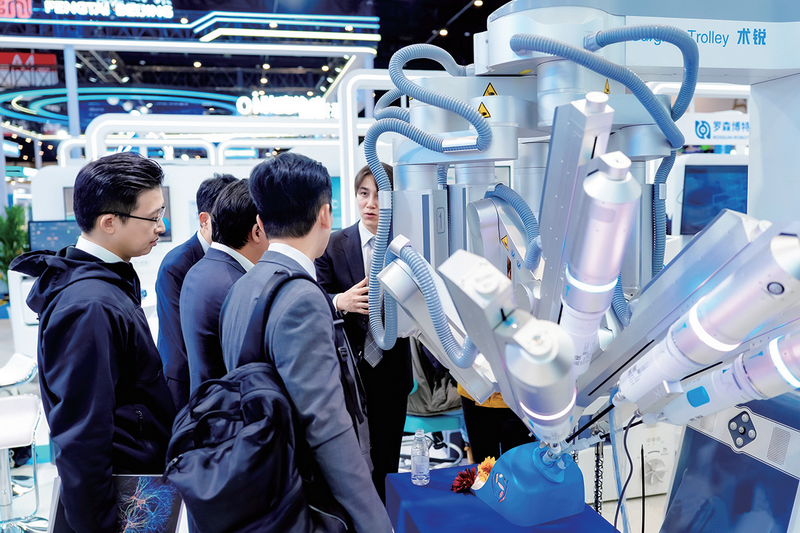
“Relying on the Beijing Medical and Health Trusted Data Space, Haidian is consolidating the infrastructure foundation for medical data circulation and utilization. Currently, Haidian District has gathered over 100 AI pharmaceutical and health enterprises, covering core directions such as model development, new drug R&D, medical imaging, and clinical diagnosis and treatment. We provide safe and compliant data element support for AI pharmaceutical innovation, breaking down barriers to trusted data circulation. The industrial chain hierarchy is clear, presenting an effect of ‘the government sets the stage, enterprises put on the show,’” a responsible official from the Zhongguancun Science City Data Group told the reporter.
On the screen, algorithms operate at high speed, but the ultimate landing point is real clinical scenarios. The reporter saw on-site that enterprises including BioMap, DP Technology, LinkDoc, StoneWise, DeepCell, and AIPher were exhibiting in a concentrated manner. A responsible official from an exhibiting enterprise stated: “Many people still think AI drug development remains only at the paper research stage. In fact, we already have related projects advancing to the clinical stage.”
Beyond AI, source innovation is equally intensive. According to on-site staff, Haidian enterprises have seen concentrated breakthroughs in innovative drugs this year: SeDomingji Injection developed by Northland Biotech, the world’s first naked plasmid gene therapy drug based on HGF, has been approved for market launch; Imunopharm’s core product IM19 chimeric antigen receptor T-cell injection is applying for market approval, and is expected to become the first domestically self-developed CAR-T cell therapy drug of its kind to be approved in China; YN001, the world’s first targeted drug for reversing atherosclerotic plaques, has entered pivotal clinical trials; and an innovative drug targeting the mitochondrial respiratory chain has completed Phase II trials.
“From target discovery to clinical trials, the team’s main processes were all completed in Haidian. The university and hospital resources here have significantly shortened the transformation cycle”, the person in charge of an innovative drug enterprise booth told the reporter. At the exhibition area, multiple enterprises exhibited in a concentrated manner, presenting Haidian’s industrial closed loop for innovative drugs from source innovation to market landing.
Source innovation addresses “whether it exists”, while high-end medical equipment must answer “whether it is good”. In the high-end medical equipment section, surgical robots “showed their swords” on the same stage. In the digital operating room area, China Aerospace Changfeng brought overall operating room solutions; TINAVI, Surgerii, and ROSSUM ROBOT — three surgical robot enterprises — displayed on the same stage, with robotic arms flexibly flipping in simulated tissue and suturing with precision, drawing layers of onlookers. “The single-port surgical robot reduces the wound from multiple incisions to a single small port, significantly shortening patient postoperative recovery time”, a Surgerii booth staff member explained while operating. From diagnosis to surgery to treatment, a complete high-end medical equipment chain is perceptible and tangible within the exhibition area.
Beyond equipment, technology is extending deeper — into the brain. In the brain-computer interface section, visitors can observe up close the complete chain from chips and electrodes to algorithms and applications. Staff demonstrated on-site how head-mounted acquisition equipment reads EEG signals in real time and controls external devices, with many people queuing to experience it. Among these, BCIFLEX brought neuron-level high-throughput implantable flexible brain-computer interface systems, electrode implantation robots, intracranial deep flexible electrodes, digital electroencephalographs, and other core products to make a concentrated debut, becoming one of the most attention-grabbing booths on-site. “Our over 100-channel implantable flexible brain-computer interface system has initiated prospective, multi-center registered clinical trials, and multiple subjects have already been enrolled”, on-site staff introduced.
Multiple Support, Industrial Challenges Solved One by One
After viewing the exhibits in the exhibition area, a question naturally follows: Why can these enterprises string together a complete chain in Haidian? The answer first lies in the strong talent reserve. Relevant data shows that Haidian District’s academicians of the Chinese Academy of Sciences and the Chinese Academy of Engineering account for 35% of the national total, reaching 692 people; among them, 124 academicians in the pharmaceutical and health field account for 21.7% of the national total; 183 National Distinguished Young Scholars account for 11.9% of the national total; and it has over 8,000 pharmaceutical and health teaching and research personnel, accounting for 84.7% of Beijing. In terms of scientific research, 37 universities, 96 national-level research institutions, and 26 national key laboratories in pharmaceutical and health are gathered here. In terms of clinical practice, Haidian has gathered over 1,000 medical institutions, including 56 secondary-level and above medical institutions, with 2 national medical centers and 9 national clinical medical research centers, ranking among the top in the country in clinical innovation resources.
“What we want to do is make these resources an innovation foundation within enterprises’ reach”, a responsible official from Zhongguancun Science City told the reporter. In response to the practical challenges enterprises encounter in development, Haidian has put forward a complete set of solutions, centrally showcased at this exhibition.
Medical data “dare not be used” — Haidian breaks down departmental barriers, implements the “three medical linkages” mechanism, coordinating multiple entities in healthcare, medical insurance, and pharmaceuticals to work together in synergy, and accompanies it with the “Haidian District Pharmaceutical and Health Industry Three-Year Action Plan (2024–2026) ”, providing an annual industrial policy package of no less than RMB 250 million, supporting enterprises from R&D, transformation, to landing at every stage. With 2 national medical centers and 9 national clinical medical research centers gathered here, enterprises’ algorithms and products can be rapidly verified in real clinical scenarios. “In the past, one project had to connect with multiple departments. Now, under the three medical linkages mechanism, enterprises can solve a string of problems by finding one task force”, said an enterprise representative who had just completed matchmaking in the negotiation area with sentiment.
Achievement transformation “no one to pick up” — Haidian has formed 8 special service task forces and a 249-person service team through the “Five Parties, Six Forces” university-locality collaborative mechanism, achieving 1,010 sci-tech innovation projects in the database, promoting 247 projects to land and transform, and building a one-kilometer-around-university achievement transformation circle, allowing scientific research achievements to find matchmaking parties without leaving the school gate.
Project funding “can’t be found” — Haidian has built a RMB 30 billion-level “three-circle investment” fund matrix, gathering a batch of biomedical professional investment institutions to share the costs of frontier exploration with long-term capital; at the same time, it has released over 2 million square meters of quality industrial space, with key parks such as the Zhongguancun Science City International Medical Valley, the Zhongguancun (Haidian) Bio-Intelligent Manufacturing Industrial Park, and the Sijiqing Life Science&Technology Park making their concentrated debut, covering the full cycle from concept verification, pilot-scale testing to large-scale production, so enterprises don’t have to worry about “the first laboratory” and “the first production line”.
A responsible official from Zhongguancun Science City stated that in the future, Haidian will continue to leverage the resource agglomeration advantages of the “national team”, taking the three medical linkages, industrial policy package, and professional services as the starting points, to promote more pharmaceutical and health achievements from the laboratory to the clinic and the market.