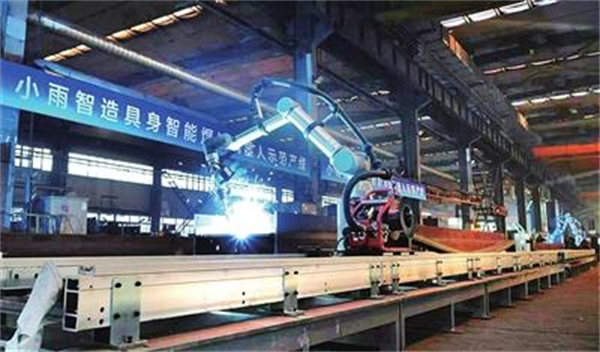
A worker's "pen" lightly traces across a steel plate, and the embodied intelligent robot finds its position on its own. Amid flickering arc light, a uniform weld seam takes shape. On October 27, the "Industrial Embodied Intelligence Welding and Inspection Technology Joint Laboratory," co-built by Haidian enterprise Beijing Xiaoyubot Intellisys Co., Ltd. (hereinafter "Xiaoyubot") and the National Steel Structure Quality Inspection and Testing Center of MCC Central Research Institute of Building and Construction Co., Ltd. (China's only national-level quality inspection center in the steel structure field), was officially unveiled in Haidian District. This means that the steel structure welding industry—once characterized by "master workers relying on experience, good welders hard to find"—has welcomed a new member capable of both doing the work and passing the "national exam."
Robots Gain the "Touch of a Veteran Worker"
Teaching a robot the "touch of a veteran worker"? The day before the laboratory was unveiled, Xiaoyubot had just announced its first customer case.
Walking into the workshop of Beijing Beipao Light Steel Building Materials Co., Ltd., amid flying sparks, 12 welding robots are smoothly navigating the complex grooves of non-standard steel components. They have no fence isolation and require no on-site teaching by engineers. When encountering material deviations, they adjust their posture autonomously, welding and adjusting as they go; after finishing one seam, they turn and head to the next workstation. Standing nearby, operator Yang Chao holds a positioning pen and lightly traces across the workpiece, and the robot "understands" the task.
"Watch the operation in the morning, get hands-on in the afternoon." Yang Chao said this in an ordinary tone, yet it reveals an extraordinary change—she was originally a cutting worker and had never touched a robot. Now, the newcomers she trains can independently operate six pieces of equipment in two or three days.
This scene is taking place at Beipao Group, a state-owned enterprise with a history of more than 40 years. Zhu Xiaodong, chairman and general manager of Beijing Beipao Light Steel Building Materials Co., Ltd., admitted that the company, which has been through more than 40 years, once faced trouble inside and out. Externally, market competition was increasingly fierce, and customers' demands for construction periods, costs, and quality continued to escalate; internally, manual welding quality was unstable, senior welders were increasingly difficult to recruit, non-standard workpieces were numerous, production lines changed frequently, and traditional robots were difficult to adapt to.
The company had inspected about ten companies doing welding automation and tried introducing several types of equipment, but none worked. "Not only did it not reduce costs, but we also had to hire engineers to specifically 'serve' it," Zhu Xiaodong recalled. The original intention was to reduce costs and improve quality, but instead costs increased.
The turning point came after coming into contact with Xiaoyubot. This general-purpose embodied intelligence company, founded in 2023 by Qiao Zhongliang, a former core founding team member of Xiaomi Group, follows a "one brain, multiple forms" technical route—using a general embodied brain as the core to drive robots of different forms to handle different industrial tasks. Unlike the industry's rush into humanoid robots, Xiaoyubot has continued to deepen industrial implementation over the past three years, identifying welding as its first application scenario and officially releasing the Xiaoyubot Future Robot in July this year.
What opened Zhu Xiaodong's eyes was the equipment's ability to "think autonomously like a human": it can understand workpieces of different shapes and automatically bypass obstacles; the operation threshold is low—just trace with a positioning pen to weld, and anyone who can use a smartphone can get started; more importantly, there is no need to stop production to modify the production line—a single unit can be operational in 4 hours.
Beipao Light Steel decided to start with a small-batch pilot. The results quickly showed up. Zhu Haimeng, technical head of Beipao Light Steel's Tianjin factory and an international welding engineer, was most impressed by "adaptability": "Non-standard workpieces always have some deviations when they arrive, but Xiaoyubot's robots can adapt on their own, welding and adjusting as they go, greatly reducing rework and repair welding." He gave an intuitive example: "Coating is an amplifier. After spraying, the quality gap between manual welds and Xiaoyubot's welds can be distinguished at a glance."
Yang Chao was deeply impressed by the robot's "memory": "It remembers. For small problems encountered before, when doing the same work again not long after, it smooths things out on its own. Engineers say this is autonomous learning—it really gets better with use."
After the first batch of equipment operated stably, Beipao Light Steel immediately repurchased and expanded the scale of application on the production line. The application gave the most practical answer: after deploying 12 Xiaoyubot Future Robots in one workshop, data from August 2026 showed that monthly production capacity increased by 30% compared with before the transformation, comprehensive costs under the same welding quality conditions decreased by 49%, and a single machine produced about 90 meters of equivalent fillet welds per day on average, with simultaneous improvements in weld-forming consistency and product quality.
In addition, Beipao Light Steel has newly established the position of embodied intelligent robot operator, and Yang Chao, who originally did cutting, was the first to transition; veteran workers are concentrated on higher-difficulty, more technically demanding welding processes; workshop management, with the help of online management dashboards and mobile apps, has been upgraded from the past "person watching person" to systematic management that grasps production, working hours, and equipment status in real time. "Efficiency is up, quality is stable, and employment pressure has been eased," Zhu Xiaodong said.
Making Every Weld Seam Stand Up to Inspection
The Beipao Light Steel case is a microcosm of Xiaoyubot's industrial implementation. Currently, Xiaoyubot Future Robots have been routinely deployed in more than 20 factories, covering industries such as building steel structures, shipbuilding, and power transmission towers, with monthly weld seam length in real production environments exceeding 100,000 meters. The establishment of the joint laboratory marks the deep integration of national-level authoritative inspection capabilities and frontier industrial embodied intelligence technology—processes verified in the workshop will undergo item-by-item inspection against national standards here.
According to the company, the joint laboratory will use national-level steel structure inspection standards as a rigid yardstick to carry out embodied intelligent robot welding process development, sample testing, and performance verification. At the same time, it will cultivate interdisciplinary intelligent welding talent for the steel structure industry, making embodied intelligent welding truly safe, stable, precise, reliable, and fully inspectable throughout the process, contributing to the intelligent upgrading of China's steel structure industry and the development of new quality productive forces.
A laboratory team appointment ceremony was held simultaneously at the inauguration. Among them, Zhou Shuchun, head coach of China's national team for the WorldSkills Competition welding event, and Zhao Qiansen, gold medalist in welding at the 48th WorldSkills Competition, serve as expert committee members. Zhou Shuchun, who has coached four WorldSkills champions, said: "The craftsmanship remains unchanged; what changes is the tool in our hands. Chinese welders weld the world. The next generation of welders must take China's robots and weld the world once again."
Wang Haitao, party secretary and general manager of MCC Building Research Institute, offered an analogy: "The WorldSkills Competition represents the ultimate in 'human' welding craftsmanship, while embodied intelligence explores the upper limit of 'machine' welding capability. Our laboratory must pave an 'inspectable, reproducible, and scalable' process channel between the two."
Qiao Zhongliang stated that Xiaoyubot invited national-level master craftsmen to join in order to let craftsmanship, skills, and experience settle into an inheritable process foundation, and then rely on the laboratory to cultivate a new generation of welders who understand processes and, more importantly, AI.