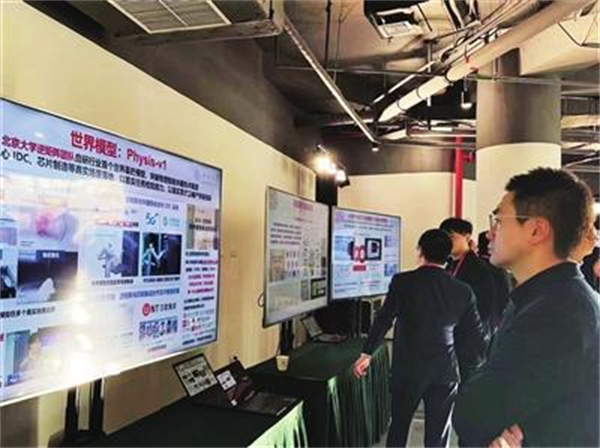
In the shared exhibition hall, Peking University's scientific and technological achievements are showcased in a concentrated display.
Stepping into Weiming AI Park, open workstations are lined up under warm lighting, while shared meeting rooms and negotiation rooms exude a crisp, "ready-to-work-anytime" efficiency. In the shared exhibition hall, Peking University's scientific and technological achievements are displayed in a concentrated manner. The shared spaces and roadshow areas are already set up, awaiting the first batch of entrepreneurs to sit down and discuss. Looking out from the 15th floor, the Peking University campus comes fully into view.
On Nov. 18, the Haidian Weiming AI Park Artificial Intelligence Innovation Block was officially unveiled. Outside the window is Peking University; inside is the entrepreneurial front line—a new space "from laboratory to company" has opened its doors.
A "Transformation Hub" Beside Peking University's West Gate
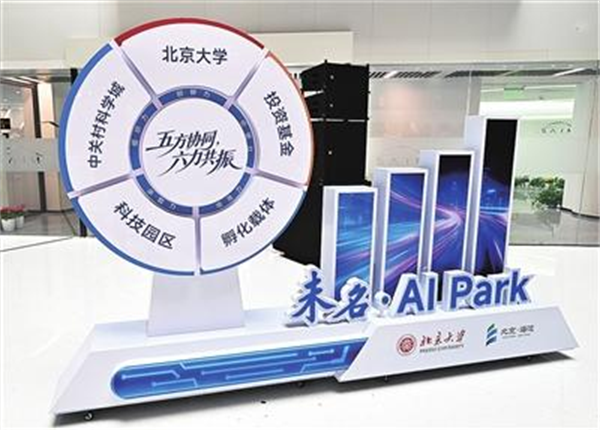
Unlike industrial parks in the traditional sense, Weiming AI Park is more like a "transformation hub" embedded around Peking University's West Gate. According to the introduction, building Weiming AI Park is an important measure for Haidian District to implement the "Three Zones and Two Wings" spatial layout of the Centennial Jingzhang AI Innovation Belt and deepen all-round university-locality collaboration with Peking University. It is also an important exploration for promoting the integrated development of education, science and technology, and talent. Weiming AI Park is jointly built by Haidian District and Peking University, with a focus on undertaking the scientific and technological achievement transformation projects of the "Wufang Liuli" Peking University working group, precisely responding to the policy orientation of Haidian District's "one-kilometer transformation circle," and is operated by Haixinyu, a district-owned state enterprise. The project focuses on the transformation and incubation of high-quality scientific and technological innovation achievements from Peking University, exploring a new cooperation model of "state-owned enterprise space + university scientific and technological innovation": Haixinyu is responsible for space construction, operation management, and innovation services, while the Office of Science and Technology Development, Peking University, serves as the coordinating partner for innovative projects and industrial ecosystem resources, enabling the university's "scientific research seeds" to find workstations, funding, scenarios, and mentors in the place closest to campus.
In terms of spatial planning, Weiming AI Park advances according to a three-tier layout of "Startup Zone—Expansion Zone—Radiation Zone." The first step is to refine and solidify the Startup Zone and create near-campus achievement transformation space. In the initial stage, it relies on two core carriers, Zhongguancun International Innovation Building and Future Technology Building, with a total floor area of approximately 91,000 square meters. Based on having already deployed two new-type R&D platforms—the Beijing Institute for General Artificial Intelligence (BIGAI) and the Beijing Institute of Open Source Chip (BOSC)—it will work with Peking University to deploy another batch of high-level scientific research platforms, joint laboratories, achievement transformation institutions, and technology enterprises, promoting the transformation of traditional commercial buildings into composite innovation spaces. The second step is to optimize and activate the Expansion Zone and undertake the landing of core industrial chain projects. In conjunction with the urban renewal of the Zhongguancun West Area, and by linking surrounding carriers such as Zuo'an Gongshe and Zhongguancun Entrepreneurship Street, it is expected to release 330,000 square meters of renewable industrial space. The focus will be on deploying Peking University-affiliated AI enterprise headquarters, leading investment institutions, and technology service institutions, while actively attracting international science and technology organizations and world-class science and technology journals to establish a presence. In addition, by coordinating the Changchun Xinyuan area, integrating the historical context of the Three Hills and Five Gardens with the innovative spirit of Zhongguancun, it will deploy ecological parks and slow-traffic blocks, improve public service supporting facilities, and create a world-class AI innovation ecosystem that is livable and workable. The third step is to strengthen and expand the Radiation Zone and promote industrial acceleration and scenario-based application. In terms of industrial acceleration, it will link northward with spatial nodes such as Guajiatun and Xiaojiahe, and is expected to release 200,000 square meters of industrial space in the future. Focusing on frontier interdisciplinary innovation directions such as embodied intelligence and AI for Science, it will provide supporting industrial acceleration services such as pilot testing and validation, supply chain matchmaking, and market expansion. In terms of innovative scenarios, relying on the construction of key projects such as the Arthur M. Sackler Museum of Art and Archaeology at Peking University and linking with the Xiaojiahe "Green Dynamic World" Sports Park, it will deploy AI + culture and AI + sports, create perceptible and implementable AI-themed application scenarios, and shape a model AI innovation block where technology, humanities, and ecology blend.
Why was the core area chosen at Peking University's West Gate? The answer lies in Haidian District's "one-kilometer transformation circle." According to the responsible person of Zhongguancun Science City, in recent years, Haidian District has continuously improved the "Wufang Liuli" mechanism, supported the deployment of "one-kilometer transformation circles" around universities and research institutes, and encouraged leading incubators to connect with university technology transfer institutions. For entrepreneurs, this "one kilometer" is not only a geographical distance, but also the "critical leap" from laboratory technology to business plan, from prototype to product, and from first order to financing. The responsible person offered an analogy: "A professor produces results in the laboratory; stepping out the door and walking one kilometer, they can find a fully furnished office ready for move-in, and also connect with computing power, policies, capital, and customers."
Move In and Start Working; Upstream and Downstream Are in the Same Building
Entering the core Startup Zone, the spatial planning is practical and straightforward. The open office area is suitable for startup teams of 2 to 5 people, while independent office areas are reserved for growth-stage enterprises of 5 to 20 people; small meeting rooms, negotiation rooms, a reception desk, a pantry, and a lounge area are all available.
Cheng Yue, Chairman of Beijing Haidian Urban Renewal Development Co., Ltd., told reporters that in terms of industrial direction, the park is guided by Haidian District's "1+X+1" modern industrial system, with a focus on artificial intelligence, including large models, computing infrastructure, AI chips, AI + industry applications, generative artificial intelligence, computer vision, natural language processing, robotics, and embodied intelligence.
In terms of operating model, the core Startup Zone builds "one core leading, two wings supporting, three rings interlinked": with deep accompaniment of university scientific and technological achievement transformation and hard-tech entrepreneurship as the core, linking Peking University departments, key laboratories, and alumni resources on one hand, and Haidian's industrial leaders and application scenarios on the other; at the same time, it cultivates in tiers according to "seed stage—incubation stage—acceleration stage," tracks enterprise growth with digital archives, and accelerates financing through capital networks.
The core Startup Zone will also build the "Yanhaihui" ecosystem cluster service system, allowing the five "tribes" of computing power, scenarios, capital, empowerment, and community to support each other. Cheng Yue said: "Through scenarios such as Haidian District's smart hotels, smart campuses, smart healthcare, and smart government affairs, we form a 'scenario opportunity list,' turning 'enterprises seeking scenarios' into 'scenarios seeking enterprises'; we hold a 'Peking University Roadshow Day' every quarter, partnering with funds and investment institutions to provide full-chain financing services from seed round to Series A; entrepreneurial mentors, policy stewards, and intellectual property services form an 'accompaniment team' to help scientists take fewer detours."
More noteworthy is the agglomeration of the industrial chain. "In terms of funding, we mainly rely on Haidian District policies, and the incubator also provides supporting support," Cheng Yue told reporters. The core Startup Zone is forming a one-stop service chain of "computing power + data + tools," and the prototype has already begun to take shape. In addition, the core Startup Zone links university-level public platform resources such as the Peking University High Performance Computing Center and the Institute for Artificial Intelligence, providing settled projects with support for frontier algorithm models and pre-trained models. In terms of services, the park provides full-cycle services ranging from registration and landing, finance and taxation, and intellectual property to talent, policy, market, technology, and computing power.
**Clear Admission and Incubation Cycle, Tiered and Continuous Cultivation of Enterprises**
What kind of enterprises can move in? "The core Startup Zone mainly targets startups and incubation-stage enterprises, with a key focus on whether the technological prospects and project types are suitable for incubation," Cheng Yue told reporters. "One-person teams, small teams of 3 to 5 people, and small-scale enterprises can all apply. Settled projects must have at least one core founder from Peking University, must have core intellectual property rights, and their registered address and main R&D and office premises must be located within the park."
Projects undergo a five-stage review process: "application acceptance—qualification review—expert evaluation—final decision—signing and settlement." A review panel composed of technical experts, investment experts, and entrepreneurial mentors conducts a comprehensive evaluation focusing on team composition, technological innovation, market prospects, business model, and investment risk.
In terms of space allocation, the core Startup Zone will provide each settled project with an office area of no more than 100 square meters; for smaller teams, it supports leasing in the form of workstations. Incubation agreements are signed on an annual basis, and the cumulative incubation period shall in principle not exceed 36 months. "When an enterprise expands, requires more than 100 square meters of office space and needs to enter the acceleration stage, or obtains qualifications such as National High-tech Enterprise or specialized and sophisticated SMEs, it can basically graduate," Cheng Yue said with a smile.
"Graduation" is not the end, but the entry into the next stage. According to the spatial succession arrangement, after graduating from the core Startup Zone, enterprises can move to the Deep Core Zone to obtain large-scale office space, with a focus on connecting with Peking University-affiliated AI enterprise headquarters, leading investment institutions, and technology service institutions. When enterprises further expand and enter the pilot testing and supply chain matchmaking stage, they can also enter the Industrial Radiation Zone to obtain acceleration services such as pilot testing, supply chain matchmaking, and market expansion. This forms a continuous development path of "incubation in the core Startup Zone—landing in the Deep Core Zone—scaled development in the Industrial Radiation Zone."
The Full Transformation Chain Runs Within "One Kilometer"
Starting from here, the path of scientific and technological achievement transformation is not complicated: achievements in Peking University laboratories can be brought a few steps to the core Startup Zone for proof of concept, team formation, and first-round financing; after three years of incubation and growth, they are then sent to the Deep Core Zone and Industrial Radiation Zone for scaled development. A path of "Peking University source—Weiming AI Park incubation—park acceleration—Haidian industrialization" is gradually running smoothly within this "one-kilometer transformation circle."
Next, Haidian will use Weiming AI Park as a fulcrum to leverage more innovation resources to gather around Peking University and radiate across the entire Haidian District, cultivating more frontier technologies, high-quality projects, and high-end talent; it will serve as a partner in Peking University's innovative development and, together with government, industry, academia, research, and finance, build a solid foundation for innovation based on university-locality co-construction and industry-city integration, making new and greater contributions to serving the country's high-level scientific and technological self-reliance and self-strengthening.
Standing by the window, the Peking University campus is quiet and familiar; turning around, the stage for AI entrepreneurship is already set. The name Weiming AI Park connects Peking University on one end and new AI seedlings on the other. Haidian's "one-kilometer transformation circle" is turning from a planning diagram into offices with lights on, roadshows, and handshakes.