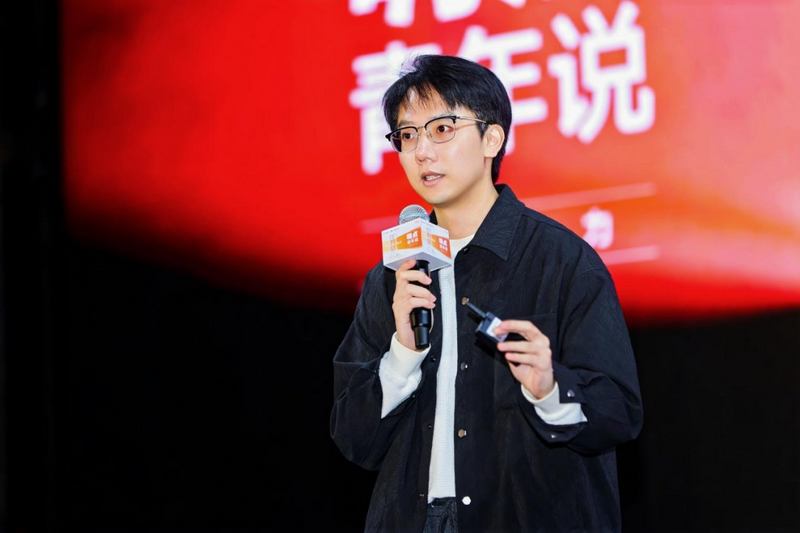
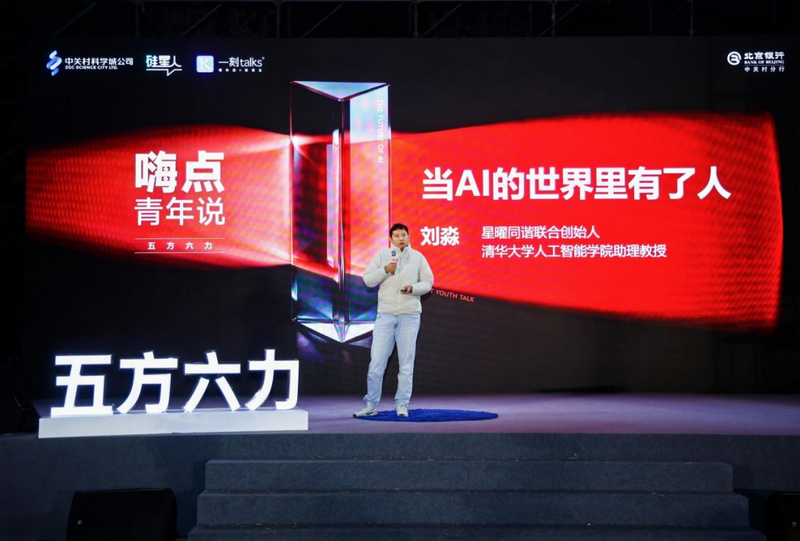
On the evening of October 23, as darkness settled over Haidian Park, the stage lights came on. Below the stage, hotpot bubbled on the tables; on stage, the eight young AI speakers were even more electrifying. The "Hi-Point Youth Talk" at the 2026 AI Creator Carnival took place here, with eight young representatives from research and entrepreneurship taking the stage in turn for TED-style talks on their vision of an AI that is interesting, useful and delivers results. The event was streamed live, carrying Haidian's AI voices to creators around the world.
Breakthrough: From Snowy Mountains to Quantum, from "Can Do" to "Doing It Right"
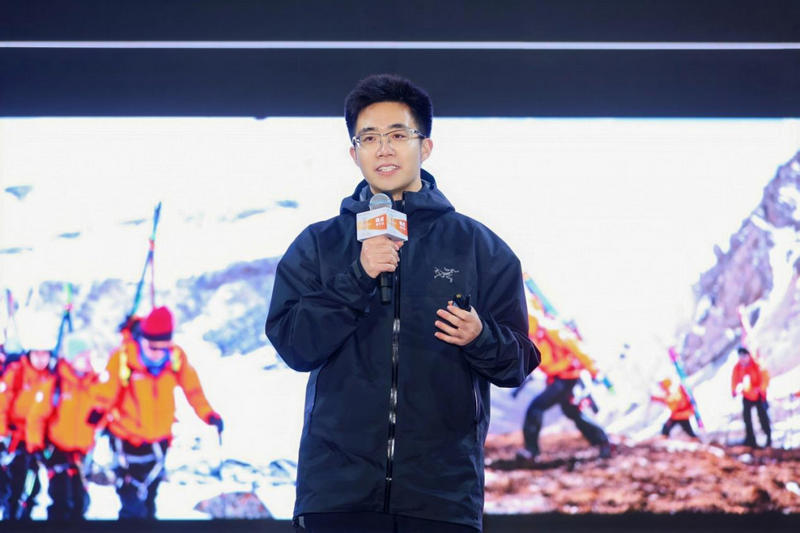
The first speaker, Fan Yaoyuan, is founder and CEO of NK-Quantum and holds a PhD in quantum electronics from Peking University. On stage, he spoke of the starry sky above the snowline of the Qilian Mountains and of ultracold atoms in the laboratory. Mountain climbing and skiing, and quantum computing, seem unrelated, but in his telling they became one story: entrepreneurship is like climbing a ridge. Sometimes the summit is out of sight, yet you are already on the way up. According to Fan, NK-Quantum pursues a dual-drive strategy of quantum simulation computing and universal quantum computing. In the fourth quarter of this year, the company will release its "Qiyuan" series of universal quantum computers. The NK-1 has already entered volume sales, and the NK-2 is scheduled for launch in the first half of next year. "With the most truth-seeking and pragmatic attitude, we do the most idealistic things," Fan said.
If Fan spoke of pushing into the extreme cold, Huang Chao, founder of Lingchuang Wanxiang and an assistant professor at the University of Hong Kong, spoke of moving toward the real world. He reframed the question from "Can AI write code?" to "Is AI being used in the right place?" AI executes ever faster, yet people are busier than ever, reviewing the hundred proposals AI generates in one go. The future gap in AI lies not just in speed, but in making sound judgments in a dynamic, open, real world where there are no standard answers. "Intelligence is AI's capability; using it in the right place is wisdom," Huang said.
Application: AI in the Lab, on Rockets and at Home
Moving on from judgment, AI begins to enter the laboratory. Yang Ling, co-founder of PhAILabs and an assistant professor at Peking University, joked that he "teaches people to do research by day and lets AI teach research by night." He said a paper is merely a "finished photograph" of science; for AI to do research, it needs the full "footage," and in particular must record failed experimental trajectories as teaching material. The team, together with BGI Group, built a "dry-wet closed-loop" system: data analysis in the computer, automated experiments in the lab, and then linking the results for validation. He predicted that the bottleneck for AI in research will eventually shift from computing power to high-quality scientific data.
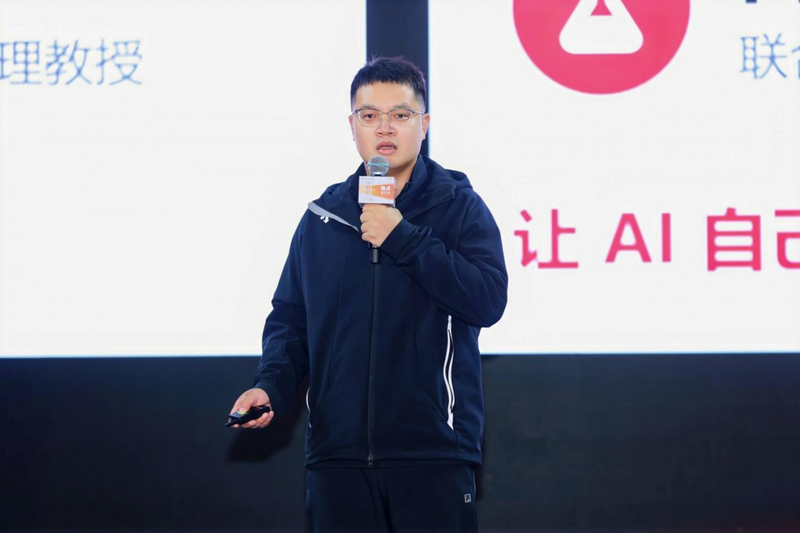
Beyond the laboratory, AI can also go aboard rockets. Mao Runze, co-founder of LegendSpace, brought the evening's most hardcore story. Traditional rocket engine development takes five to eight years, with data fragmented across design, analysis, manufacturing and testing. LegendSpace, incubated at the AI for Science Institute, Beijing (AISI) and spun out of the Peking University College of Engineering, has developed its own "Prime" agent, enabling AI to participate in design, simulation, manufacturing and testing. For a 500-newton orbital control engine, AI produced nearly a hundred feasible proposals in one hour, arrived at the optimal configuration in the digital world in about a week, and ultimately printed only one prototype and conducted a single hot-fire test, with key parameters deviating from design parameters by about 1 percent. The company was founded in January this year and had produced two engines by June.
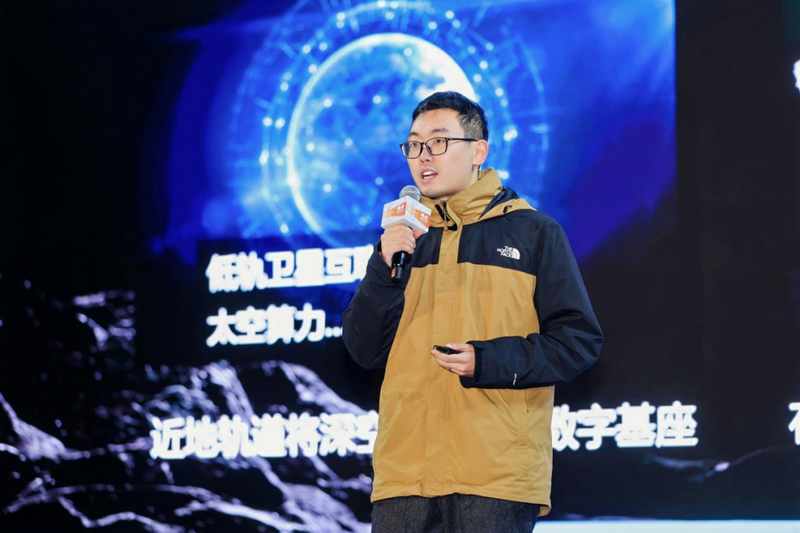
Liu Miao, co-founder of StarWith and an assistant professor at the Institute for Artificial Intelligence, Tsinghua University, spoke about "coming home." He holds up Jarvis from The Avengers as an ideal model: AI should not be a passive tool but a partner that remembers your past, understands your present and anticipates your next need. It should also have a sense of propriety, knowing when to interact and when to stay silent, treating silence itself as a decision. The team is building a human-centered foundation model and, through "test-time adaptation," enables robots to learn as they live with you after arriving at your home, tailoring themselves to each person. He said embodied intelligence entering factories and entering homes follows two different logics: factories demand precision and rhythm, while homes demand generalization and interaction.
Symbiosis: Partners, Games and Brain-Computer Interfaces
As AI moves from laboratories and factories into daily life, the question becomes whether it can be trusted. Feng Shutong, CEO of ABLab, spoke about how AI can become a more trustworthy partner after "graduation". He said remembering is not the same as learning. AI must be able to absorb corrections while working alongside people, and then turn those corrections into capability. The team is moving from general auditory models to real-time multimodal duplex agents, and is experimenting with "brain science + AI" to study which memories are worth keeping and which parts of a model should be updated. "How we teach AI today determines whether AI is worth trusting tomorrow."
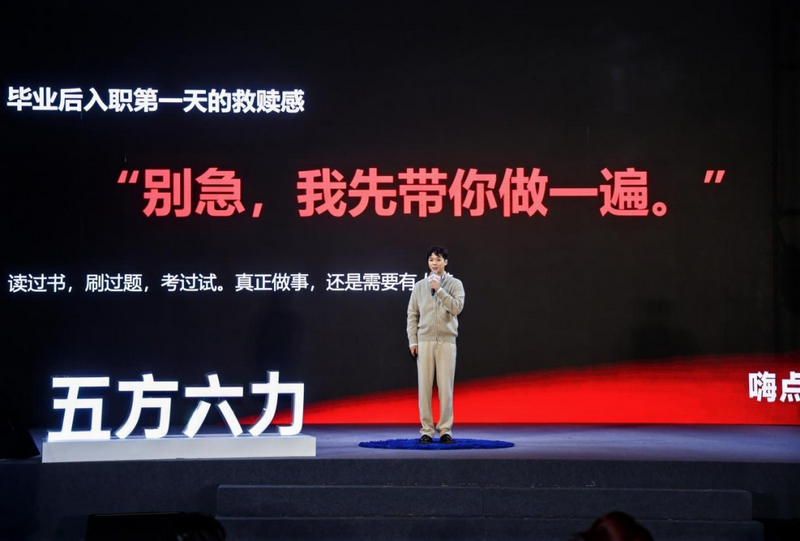
Trust extends beyond work and into games. Xin Jie, producer of the AI interactive product World Apart, brought a story of going from "players won't buy it" to "players really bought it." According to reports, the game was once jokingly called a "AAA title" by players: AI graphics, AI plot, AI gameplay. Three weeks after its Early Access launch, total sales exceeded 260,000 copies, with a positive review rate approaching 90 percent. What players recognized was not merely AI generation, but the hyper-realistic experience delivered by AI graphics, NPCs capable of conversation, and a low-threshold creation workshop. Xin Jie said that when AI can deliver 60-out-of-100 content, 60 points becomes the new zero, and the production team must continuously deliver content that exceeds AI's upper limit.

One step beyond games lies the brain-computer interface. The final speaker, Chen Xingru, appeared via video link. She is President of Emotiv China and founder of PronoiaCapital. From clay tablets and touchscreen phones to brain-computer interfaces, she painted a picture of "controlling everything with the mind": non-invasive brain-computer interfaces have already been applied to brain-controlled games, artistic creation and disability assistance, while technologies such as thought-to-text typing and silent mind-reading continue to break through. In the future, interaction may be completed by thought alone, without keyboards, screens or even language. But she also acknowledged that humanity still has a long road to travel before consciousness can be fully digitized.
Ecosystem: Five Parties, Six Forces, and Haidian Youth in the Spotlight
As the eight speakers finished in turn, the hotpot below the stage was still steaming. The reporter noted that the main visual pillar, with five faces and six corners, was shaped precisely like Zhongguancun Science City's "Five Parties and Six Forces": organizational force guiding the overall effort; the innovation force of universities and research institutes providing a steady supply; the value force of investment funds giving a strong push; the cultivation force of incubators quietly supporting; the carrying capacity of science parks steadily undergirding; and market forces completing collaborative validation. These forces weave into a net, and the people sitting in the audience are the ones who hold it together.
In 90 minutes, eight speakers, none of whom kept returning to parameters. They spoke of starry skies over snowy mountains, an engine built in two weeks, NPCs you can talk to in a cultivation world, the sense of boundaries learned from a two-year-old, and a speed-limit sign hidden by a tree at a German driving school. This is perhaps the most concrete form of "interesting, useful and results-driven": interesting in topic, useful in method, and results-driven because they had the courage to bring it on stage. The second half of the AI race is a contest of talent and generations. The answer from these young AI talents in Haidian is a grounded one: with the most truth-seeking and pragmatic attitude, they do the most idealistic things.
It was learned that Hi-Point Youth Talk, a spinoff of the video podcast Hi-Point Roundtable, is a TED-style talk program for young AI talents that originated in Haidian and was held for the first time during the 2026 AI Creator Carnival. Grounded in Haidian's "Five Parties and Six Forces" ecosystem for turning scientific and technological achievements into applications, the program connects young AI entrepreneurs across the country and invites AI entrepreneurs, core technical talents and research scholars to share AI achievements, frontier insights and entrepreneurial stories, steadily building an annual IP for Haidian's AI sector. The program also serves as a showcase for Haidian's young AI innovators and is expected to further activate talent linkages within the innovation ecosystem.
The night deepened, the moonlight lingered, and the steam from the small hotpots slowly dispersed. Hotpot has a price; the future these young people served up is priceless. That may be the most tangible "bill" of the evening at Haidian Park.