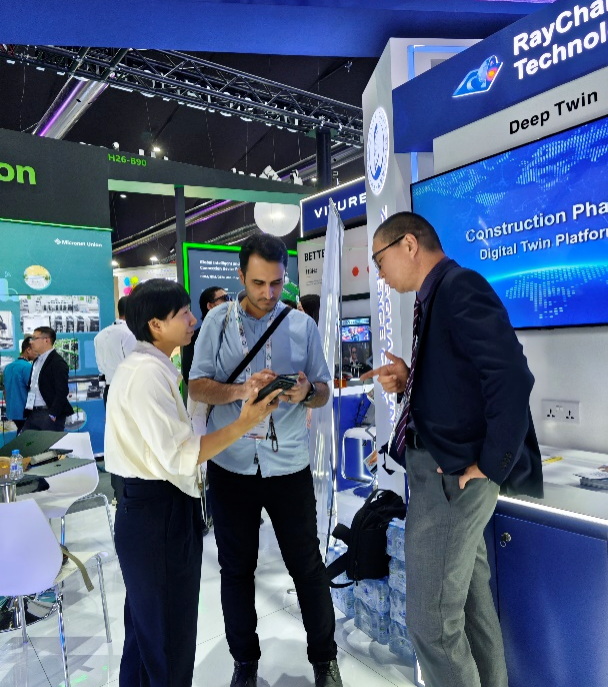
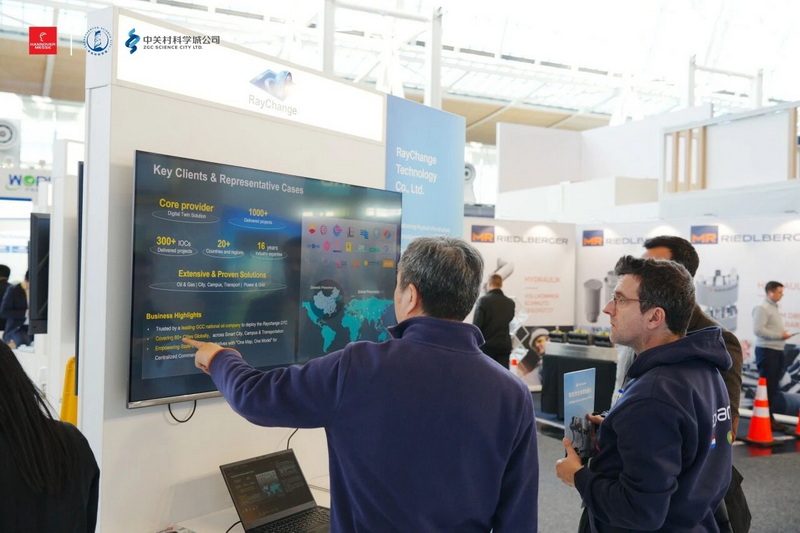
For small and medium-sized enterprises (SMEs) going global, the biggest fear is unfamiliarity with the local market and environment. Haidian-based Beijing RayChange Information Technology Co., Ltd. (hereinafter referred to as "RayChange") opened the door to Saudi Aramco, the global oil and gas giant, through a single exhibition — and went on to sell its digital twin solutions to more than 20 countries and regions worldwide. Behind this success is the "exhibiting abroad" service model explored by Zhongguancun Science City: bringing enterprises together to participate in exhibitions as a group, backed by official delegations, on-site matchmaking, and coordinated ecosystem support — turning "going it alone" into "going global together."
One Exhibition Opens the Door to a Top-Tier Client
The story begins with GITEX GLOBAL (the tech and AI exhibition) in Dubai in 2023. As one of the largest and most prestigious tech exhibitions in the Middle East, it offers big opportunities — but for SMEs exhibiting on their own, booths are expensive and foot traffic is mixed, often leaving them in the awkward position of "spending big money but seeing only spectators, not clients." RayChange took a different path: joining the Zhongguancun Science City international delegation to "go global as a group."
Where does the power of "going as a group" lie? For overseas clients, the "Zhongguancun Science City Delegation" is a name that speaks for itself — a calling card of credibility. In terms of resources, the delegation provides one-stop services ranging from booth coordination and personnel introductions to local business support. Enterprises only need to do one thing — present their hard-earned strengths, such as technology and products, compellingly at the exhibition.
During the exhibition, leveraging the delegation's organizational advantages and resource connections, Xie Haizhong, General Manager of RayChange, not only established contact with a group of potential clients, but was also introduced by delegation staff to a technical lead who was bidding on a Saudi Aramco project.
"After less than half an hour of explanation, the other party said this was exactly the technology Saudi Aramco had been looking for." Xie Haizhong still remembers that day vividly. He recalled that Saudi Aramco had begun investing in digital twin technology more than a decade earlier and even released its own best-practice standards in 2020, making its supplier selection extremely rigorous.
One introduction after another, one presentation after another — and the result was a top-tier client whose annual revenue ranks among the very largest in the global oil and gas industry. Behind this lies the value of the "exhibiting abroad" service model: enterprises don't have to build an overseas network from scratch. The delegation organizers use official resources and local channels to pave the hardest part of the "cold start" for them.
Building on Services, the Delegation Becomes a "Bridgehead" for Going Global
Of course, the handshake at the exhibition is just the ticket in — the real test comes at the delivery stage.
Saudi Aramco's requirements for digital twin suppliers are nearly ruthless — extremely stringent. According to Dong Hang, Technical Director of RayChange, on the compliance side alone, the project involves 1,021 mandatory standards, over 600 recommended standards, and CCC+ safety certification. The project is a compressor station for the third phase of Saudi Aramco's national natural gas pipeline network — covering an area of 1 million square meters, involving 3 million components, and requiring construction and operation to proceed simultaneously while oil and gas production continues.
"Every day of delay in delivering the compressor station means a loss of $3 million to $5 million in revenue," Dong Hang said. The team spent a year and a half working through all the standards — and even pre-empted 20 schedule conflicts before the planned 2028 completion, helping the client avoid a 30-day construction delay. That alone reduced potential losses by over $100 million.
Passing this major test would have been impossible without RayChange's decade of accumulated experience. According to the company, in 2017, RayChange participated in Huawei's Shenzhen Longgang smart city project — China's first "from 0 to 1" benchmark in smart cities. Starting in 2018, the company followed Huawei's "ship to go global" approach, delivering projects across the Middle East, Central Asia, and Asia-Pacific, and gaining a clear understanding of overseas market logic and rules. Combined with its self-developed 8D digital twin system — covering the entire lifecycle of industrial projects from 1D documentation to 8D operations and maintenance — this is what gave the company the confidence to stand on the international stage.
If GITEX GLOBAL solved the "from 0 to 1" problem, then every subsequent exhibition has been amplifying that "1."
Not long ago, RayChange once again joined the Zhongguancun Science City international delegation at one of the world's most influential industrial trade fairs — Hannover Messe in Germany. During the exhibition, the team successfully connected with more than ten potential partners, with buyers from Canada, Italy, Portugal, and other countries, as well as industry giants like Schneider Electric, proactively coming to discuss cooperation.
"Not only did we connect with high-quality clients, but we also gained a clear insight into where the industry is heading," Dong Hang said.
This is the compound-interest logic of "exhibiting abroad": one exhibition is more than just one moment in the spotlight. According to the company, leveraging the benchmark effect of the Saudi Aramco project, RayChange has already established contact with four to five national oil companies across the Middle East, Central Asia, and Africa. On the market side, the company has set a goal of covering the Middle East, Central Asia, the Persian Gulf, and North Africa within the next three years, has already validated localized operating models in Malaysia and Singapore, and is currently building teams in Saudi Arabia and the UAE.
Reflecting on this path, Pi Xiaoli, Deputy General Manager of RayChange, summed up an interlocking "five-step approach to going global": policy guidance — using the official endorsement of the delegation to solve the cold-start problem; ecosystem support — leveraging Huawei's global system to stabilize the foundation; benchmark influence — using the Saudi Aramco project as a door-opener; regional promotion — using benchmarks to overcome the market's wait-and-see attitude; deep localization — shifting from "product export" to "localized operations."
Enterprises Bring Their Technology; the Delegation Takes Them Global
A single exhibition booth can bring in Saudi Aramco. A single introduction can open up an entire market. The story of RayChange is a microcosm of Haidian enterprises going global — and a vivid example of Zhongguancun Science City's overseas service practices.
According to relevant data, in 2025 alone, Haidian District organized 131 enterprises to participate in renowned domestic and international tech exhibitions, including CES in the United States, Hannover Messe in Germany, and GITEX in Dubai, UAE. Zhongguancun Science City brought more than 50 Haidian tech companies to GITEX GLOBAL 2025, with 29 enterprises featured in the core exhibition area — leveraging a nearly 150-square-meter custom-built pavilion and more than 30 ZTalk enterprise events to maximize corporate exposure and extend reach to potential partners. On the sidelines of the exhibition, the "UAE Innovation Acceleration Camp" was held, with closed-door matchmaking sessions co-organized with institutions such as the Abu Dhabi Investment Authority, visits to local ecosystem organizations, and efforts to bridge the "last mile" of policy coordination and industry-academia-research cooperation.
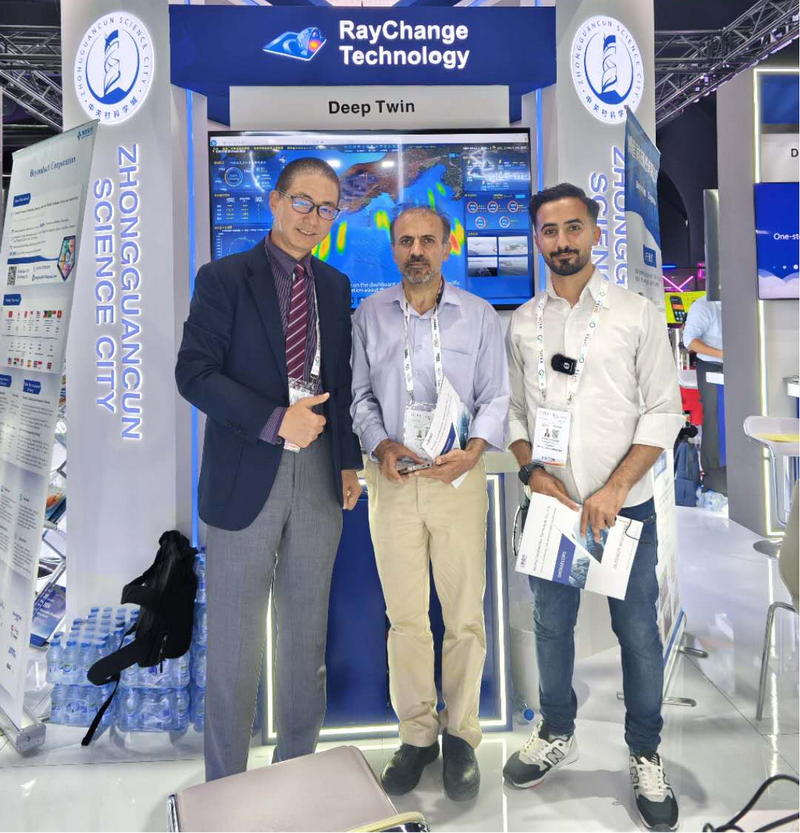
A representative from Zhongguancun Science City stated: "By organizing international delegations, linking enterprises with overseas resources, and providing full-process exhibition services, we have turned 'exhibiting abroad' into a replicable and scalable service model: enterprises bring their technology, and the delegation takes them global."