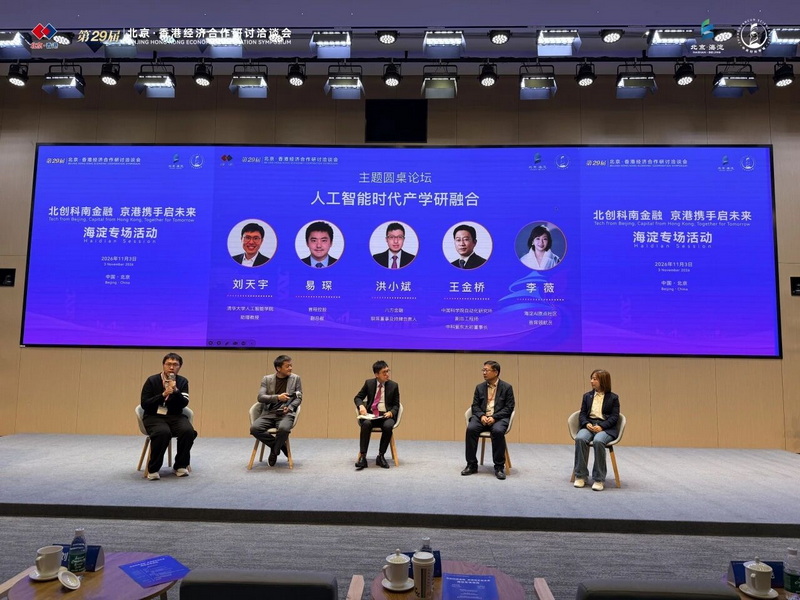
On Nov. 3, the Haidian AI Session of the 29th Beijing-Hong Kong Economic Cooperation Symposium was held at Dazhongsi Plaza. The event featured a roundtable dialogue moderated by Liu Tianyu, Assistant Professor at Tsinghua University's College of AI, with participants Yi Chen, Vice President of Shoucheng Holdings; Hong Xiaobin, Joint Director of Octal Capital Limited; Wang Jinqiao, Deputy Chief Engineer of the Institute of Automation, Chinese Academy of Sciences; and Li Wei, Chief Navigator of Beijing AI Genesis Community. The guests engaged in a dialogue centered on "Industry-Academia-Research Integration in the AI Era." At the event, the guests explored in depth the trends of AI-driven scientific discovery and the practical pathways for technology to move from the laboratory to industrial application, from four dimensions: technology, capital, parks, and academia.
From Exhibition Hall to Factory Floor: AI Extends into the Physical World
Wang Jinqiao judged that the scaling laws of large models are still evolving. Taking the latest generation of large models as an example, world models can now be built based on computer operation data, with model iteration cycles shortened to one to two months. He stated: "Abstract logical reasoning capabilities have surpassed human levels, but there are still several key tracks from digital space to the physical world."
He outlined four directions one by one: First, embodied intelligence, enabling robots to move from performance and demonstration scenarios to real production and daily life scenarios, aligning language cognition with humans' practical behavior in the world — humanoid robots are gradually entering factories and shopping malls. Second, physical world knowledge integration, incorporating physical information such as theorems, laws, pressure, and friction into models through touch and sensors — components for silicon-based entities to perceive the real world are rapidly iterating. Third, brain-computer interfaces, with invasive brain-computer technology developing rapidly, enabling machines to translate brain signals into execution capabilities. Fourth, autonomous model evolution, allowing models to achieve autonomous thinking and iterative evolution rather than retraining each time. In his view, these four directions are not concepts confined to laboratories — they are being rapidly validated by industry.
"Super Connector": Value Lies in Deep Connections
Hong Xiaobin shared Beijing-Hong Kong cooperation practices from three perspectives: publicity, talent, and industry-academia-research. He noted that in August this year, Hong Kong Polytechnic University selected 20 doctoral students to study at the Institute of Automation of the Chinese Academy of Sciences and at AI companies. During the study period, heads of Haidian AI companies demonstrated how to use decision-making large models to help traditional shoe manufacturers in Fujian optimize supply chains and increase production capacity. Hong Kong Polytechnic University immediately expressed interest in cooperation, planning to develop such cases into teaching cases for international business schools — replacing the Harvard Business Review cases that have been used for 20 years — and to establish a DTC center to "promote Beijing's scientific and technological achievements worldwide using international standards."
On the talent front, he mentioned that Hong Kong urgently needs AI talent, especially Forward Deployed Engineer (FDE) professionals, and hopes to jointly train students through industry-academia-research projects with the Chinese Academy of Sciences, allowing students to both conduct research at CAS and gain practical experience at enterprises. He also noted that the Hong Kong SAR government invested 10 billion HKD in 2023 to support industry-academia-research projects at eight major universities, with individual projects receiving approximately 100 million HKD in funding. "This funding does not take equity — it is the government's most powerful support." Defining Hong Kong's role, Hong Xiaobin said: "The value of a super connector lies not in its size, but in the depth of its connections — connecting Beijing's technology with overseas capital, and linking Haidian's industrial capabilities to global markets."
AI Is Not a Discipline, But an Industry
Li Wei put forward two judgments: First, "AI is not a discipline — it should be an industry." She drew an analogy with agriculture: agricultural development requires soil, seeds, water, and sunlight; the AI industry requires four key elements — talent, computing power, data, and capital. When these elements are dispersed, it is difficult to translate research results into products. Universities and research institutions have talent advantages; computing power and data resources are held by the government and enterprises; capital helps iterate and transform results — none can be missing. She emphasized that only by integrating all four elements can a replicable industrial paradigm be formed, enabling ideas from laboratories to move beyond papers, into parks, and onto the market — no longer stopping at the demonstration stage.
"Second, Beijing-Hong Kong cooperation is not just a combination of research and funding, but a long-term cross-regional synergy of the four key elements." She elaborated: on the talent side, promote long-term exchanges between universities and talent; on the computing power side, leverage Hong Kong's international channels to promote computing power going global and model internationalization; on the data side, connect with global markets and overseas compliant data under compliance preconditions; on the capital side, synergize on the basis of computing power and data integration. "The essence of Beijing-Hong Kong cooperation is to promote cross-regional synergy of the four elements and build a closed loop from research to industry, from China to the world."
Listing Is the Starting Point; the Market Determines Product Boundaries
Yi Chen threaded his remarks with one main line: "Research creates possibilities, product collaboration brings products to market, capital bridges the validation cycle, and the global market determines the upper limit of product development." He believes that Hong Kong's value is not just as a financing platform, but runs through the entire process of financing, overseas validation, and international market expansion. The Hong Kong Stock Exchange has broadened listing paths for tech companies, but enterprises should treat listing as a new starting point.
"Listing is just the starting point. True internationalization means international customers are willing to renew, products can be repurchased, and delivery costs are controllable." Yi Chen focused on three aspects: First, building a governance structure suitable for international business, organizing financial, intellectual property, equity, and contract systems to gain recognition from international investors. Second, acquiring high-quality international customers, finding local channels and partners in target markets, validating demand and delivery capabilities, and ultimately achieving mass production. Third, cultivating sustainable operating capabilities, adapting to local language, usage environments, service requirements, and regulatory rules, and establishing stable delivery capabilities.
In the Next 5 to 10 Years, Technology Will Redefine the Limits of Life
Liu Tianyu, who recently returned from abroad, summarized two prominent advantages of China's AI development: First, a unique industrial collaboration model — Haidian gathers a large number of AI companies, Hong Kong provides an international window, and cross-regional resource synergy is a distinctive feature. Second, the ability to concentrate resources on major tasks, channeling core resources to key areas. Biopharmaceuticals has a natural interdisciplinary nature, requiring knowledge of biology, chemistry, and simulation modeling simultaneously — a research direction of great investment value.
"AI for Science has penetrated into chip design, drug development, and other fields. EDA chip routing and testing, virtual cells, and virtual human body technologies are migrating complex experiments to virtual platforms, significantly accelerating the R&D and market launch of innovative drugs." When asked how far humanity is from extending the human lifespan, Liu Tianyu made a judgment that impressed the audience: "As intelligent agents capable of autonomously setting research goals and continuously evolving accelerate their deployment, breakthroughs in life sciences that push the limits of human lifespan may come in just 5 to 10 years."
From the scaling laws of large models to embodied intelligence entering factories, from AI empowering chip design and drug development to enterprises leveraging Hong Kong to reach global markets, this roundtable dialogue outlined a clear path: the boundaries of scientific discovery continue to expand, the pace of industrial application continues to accelerate, and Beijing-Hong Kong synergy is connecting every link along this path. As Haidian's invitation at the end of the event put it: "Come to Haidian and start a business together — every day is brand new!"