'Chaohai YOUNG Sail' International Evening School Program of Haidian Subdistrict Embarks on a New Journey
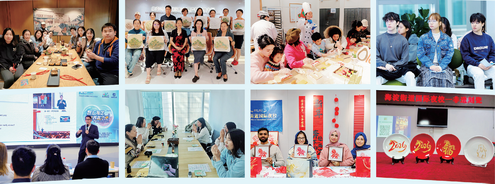
At 7 pm on March 19, 2026, the E-World International Talent Reception Hall in Haidian Subdistrict was brightly lit. More than 30 young people sat around a long table, their faces illuminated by the laptop screens before them. At the podium, a technical expert in the field of artificial intelligence was demonstrating the application of large models in office scenarios. The students took notes from time to time, or raised their phones to photograph the presentation. Scenes like this now unfold almost every weekday evening across different corners of Haidian Subdistrict.
Since launching the district's first international regional evening school in December 2025, Haidian Subdistrict has consistently focused on the core mission of "cultivating new quality productive forces, enhancing cultural appeal, and fostering interest-driven engagement". With the goals of building a world-leading science and technology park, creating an international youth-friendly neighbourhood, and expanding platforms for global exchange, the subdistrict has enriched its "Chaohai YOUNG Sail" brand. The appeal of the evening school has continued to grow, attracting increasing participation, and the concept of "Haidian as a campus" has taken root and become a vivid reality across the subdistrict.
To date, the evening school has offered over 40 courses, reaching all office buildings and enterprises in the area, the Zhongguancun West Zone business district, and 32 communities, both online and offline, with total participation exceeding 6,000.
Cultivating New Quality Productive Forces to Solve Real Business Needs
At a classroom in the DH3 teaching site in Haidian Subdistrict, a hands-on session on AI-powered marketing and customer service had just concluded. "I used to think AI was still far from practical business use, but after three sessions on related courses, I can now use AI tools to build a basic customer response system," said Mr Li from a tech company.
This sense of achievement is no accident. Haidian Subdistrict has made the "sci-tech innovation evening school" a key priority. The curriculum focuses on diverse "AI+" application scenarios, covering areas such as AI office tools, AIGC content creation, and industrial chain layout and investment. The teaching team brings together professors from neighbouring universities and leaders of sci-tech innovation enterprises. Adhering to the principle of "making technology accessible and knowledge practical", they bring cutting-edge technologies within reach through a model combining "theoretical explanation, case demonstration, and hands-on practice".
At the same time, the evening school has established a mechanism to assess course demand. Through online solicitation, voting for preferred courses, and offline consultations, it precisely identifies the needs of enterprises and their employees. A performance-based system ensures that courses with satisfaction ratings below 90 percent are discontinued. Data shows that over 94 percent of students are highly satisfied with the courses overall, and 92 percent approve of the teaching methods and classroom atmosphere. Responding to the differentiated needs, tailored programs have also been delivered to leading enterprises such as iQiyi, Beijing Institute of Open Source Chip (BOSC), DP Technology, and XDF.cn. "The course aligns perfectly with our business needs, and employee engagement has exceeded expectations," said a human resources manager who participated in a dedicated corporate session.
Conveniently located teaching sites create an "evening school at youth's doorstep". The evening school has formed a "1+7+N" matrix of teaching locations. Centered around the E-World International Talent Reception Hall, it radiates out to seven main teaching sites, including DH3, Hilon Tower, and the AI Industrial Park at Peking University's West Gate, as well as 32 community centers across the subdistrict. Over 90 percent of students commute to their classes within 15 minutes.
A representative of the evening school explained that to better accommodate busy schedules of young office workers, start-up entrepreneurs, and those in new forms of employment in the Zhongguancun West Zone, the subdistrict has adopted a flexible operating model. This means the "evening school" is not limited to the evening; "lunchtime classes" and "weekend classes" are also offered, providing different groups with flexible options and achieving a more diversified teaching model.
Enhancing Cultural Appeal: From Skills Training to Talent Gathering
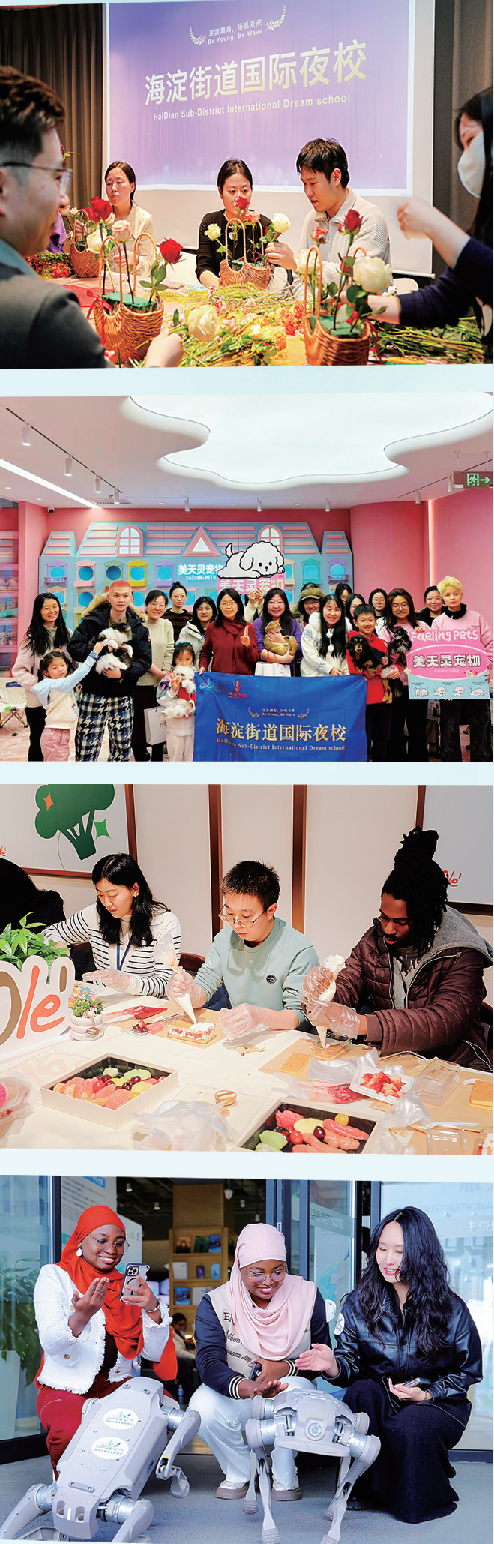
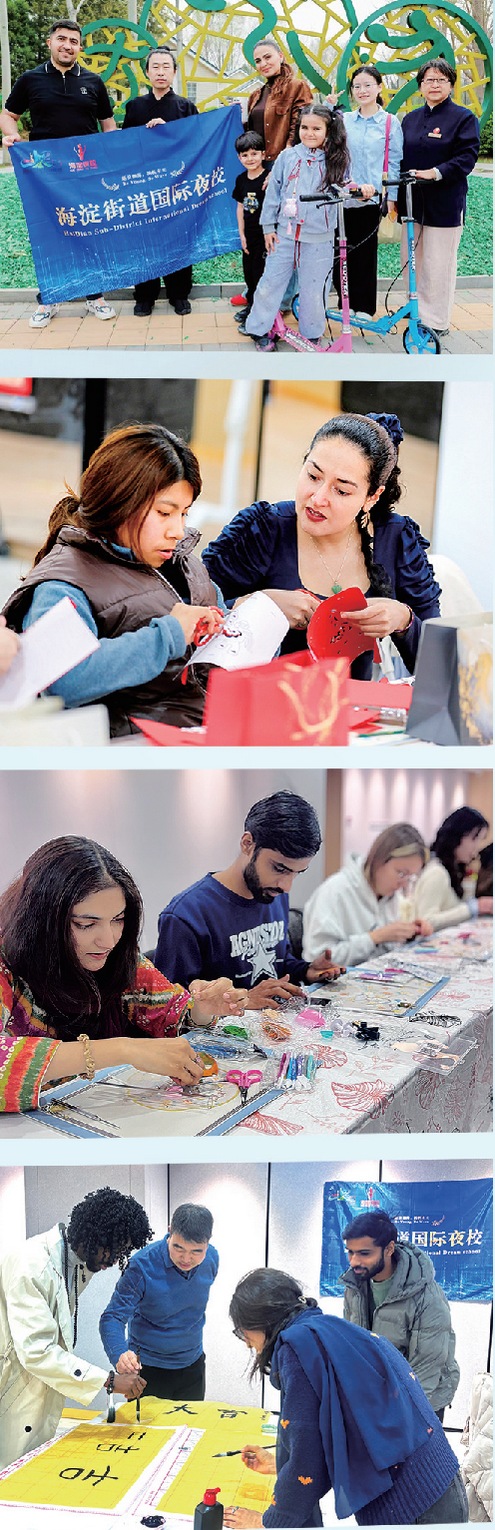
"In soft-brush calligraphy lies the structural beauty of Chinese characters. Learning it allows me to explore the profound heritage of both the characters and Chinese culture, and through this process, to understand the Chinese way of thinking," said an international student from Cuba, as he practiced regular script (kaishu) in a calligraphy class.
Currently, the proportion of international youth participating in the evening school courses has reached 45 percent. Meanwhile, in its efforts to build an international youth-friendly neighbourhood and innovate teaching formats, the evening school offers bilingual (Chinese-English) courses specifically for foreign professionals and international students studying in Beijing, creating an accessible gateway to Chinese culture and local life. In collaboration with the Chinese Service Center for Scholarly Exchange (CSCSE) under the Ministry of Education, the Beijing Overseas Talents Center (BOTC), and the International Cooperation Department of Peking University, it also regularly organizes international talent salons, study tours, and other events.
Furthermore, the evening school brings together think-tank resources and has established a diversified teacher training system. "The subdistrict has issued a recruitment notice to enterprises in Zhongguancun West Zone, recruiting more than 20 volunteers including corporate training teachers, key business personnel, and technical experts to join its teacher pool," introduced a person in charge of the school. "Meanwhile, the subdistrict has vigorously promoted a training model of 'youth inspiring youth' and 'youth leading by example'. For instance, the aromatherapy course is taught by an internationally certified instructor from Xiang Duola Beauty Academy, and the choir class is led by the founder of Flowing Tune Music Education. Professional resources from the District Federation of Literary and Art Circles, local universities, and leading enterprises in the area have also participated."
By partnering with local businesses, the evening school brings classes into cafés, bookstores, and flower shops—creating vibrant, real-world learning spaces that attract young people and energize commercial districts. At the same time, for workers in the gig economy, such as delivery workers, the school offers dedicated skills enhancement and career development courses, building a full-chain service system from skills training to career guidance. This supports every young person to thrive and grow in Haidian, forming a full-cycle support system from learning to employment. This approach is gradually evolving the evening school into a platform that integrates interest cultivation, skills upgrading, and career support.
Boosting Engagement to Guide Young People from "Online" to "In Person" Connections
"I think each movement of Baduanjin emphasizes coordination with the breath – it's not about building muscles, but about cultivating energy," a student described their experience in the "Lunchtime Arts Class". Addressing the physical and mental health needs of young professionals, the program is divided into eight major content sections, including "Lunchtime Arts Class", "Talent Gathering Class", and "Neighbourly Class". These provide a platform for diverse groups to communicate and help young professionals relieve stress after busy work.
The evening school offers classes on traditional Chinese culture, such as guqin (Chinese zither) and small seal script calligraphy, while also catering to young people's interests by providing courses in voice acting and mobile phone photography. By bringing young people together through shared interests, it breaks down social barriers, allowing them to find a sense of belonging among common hobbies, achieving a social upgrade from "single-direction learning" to "multi-dimensional interaction". This helps young people shift from "screen-to-screen" to "face-to-face" connection.
"We have been strengthening collaboration with building property managers and local educational institutions, using professional equipment to offer more specialized courses such as voice acting and guitar. By holding classes right in the business district, at the 'building doorstep', we not only bring footfall to the area but also provide more opportunities for young people to make friends," the representative said. Since its launch, the evening school has co-organized activities such as song contests and the New Year Music Festival with local buildings like DH3 and Lixiang International Tower, truly sharing educational outcomes with enterprises. Furthermore, the basic physical training courses offered by the professional teaching team from Beijing Dance Academy have gained great popularity among employees in the subdistrict, with the number of participants continuing to grow. The team has plans to set up a professional dance studio within the area, marking a shift from short-term course cooperation to the implementation of long-term services.
As evening falls, participants linger outside the E-World International Talent Reception Hall, continuing discussions sparked in class. The lights of the evening school illuminate not only their faces, but also this vibrant hub of innovation and entrepreneurship.
The representative said that the subdistrict will continue to focus on aligning supply and demand in enterprise development, using the evening school as a flexible entry point to help international talents integrate into local life. It aims to promote new nighttime scenarios for public services and consumption, driven by "government guidance, business district support, technological empowerment, and international integration", and inject lasting vitality into the construction of a world-leading science and technology park.