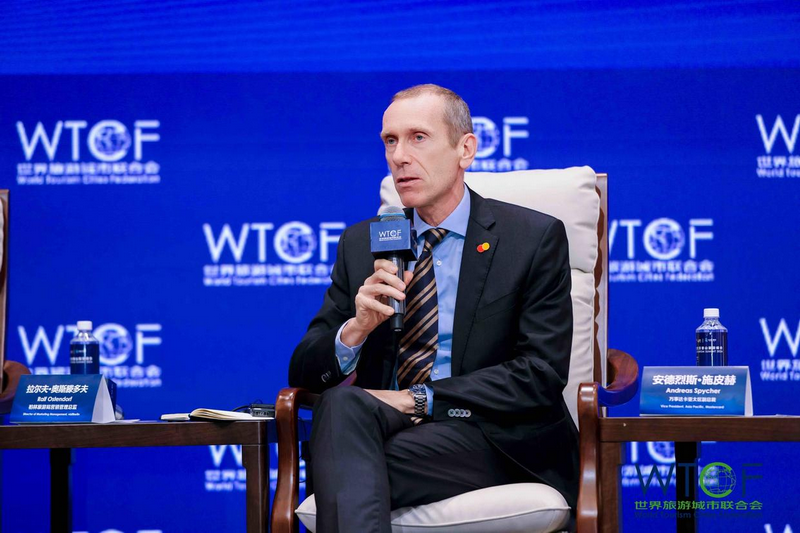
On June 2, the 2026 WTCF Beijing Fragrant Hills Tourism Summit opened. At the Special Forum on Tourism Facilitation held on the afternoon of the June 2, multiple guests delivered insightful views and contributed ideas and recommendations to advance tourism facilitation.
“China has opened up its payment systems and they are completely secure. In China, I can go cashless just like the locals.” Andres Spicher, Vice President of Mastercard Asia-Pacific, believes that China is not only open, but its tourism payments are seamless, convenient and secure.
It is reported that Mastercard has been actively promoting and participating in payment facilitation efforts since 2023. On the one hand, it has expanded bank card acceptance in core business districts; on the other hand, it has launched an “overseas card domestic binding” partnership with Chinese e-wallets, enabling inbound tourists to bind credit cards issued in their home countries to WeChat Pay and Alipay, and make scan-to-pay purchases in China just like local residents. By the first quarter of this year, the total inbound consumption amount using Mastercard has increased by more than 50% year-on-year, nearly 1.8 times that of 2019, with the growth of “overseas card domestic binding” exceeding 60%.
Image source: World Tourism Cities Federation
In terms of inbound tourism, Mastercard has been continuously launching and updating the “Priceless Beijing” experience for cardholders worldwide, curating and promoting high-quality cultural resources and tourism products with local characteristics both at home and abroad, such as hutong cycling, Great Wall climbing, and Peking Opera exploration.
“We are working with some Chinese organizations on inbound business, some of which are located in the south. We will assist in promoting hotels overseas to attract more consumption to secondary destinations beyond first-tier hot cities,” Andres Spicher revealed.
Wang Ya, Vice President of Bank of China Beijing Branch, explained that the three pillars—card payments for large amounts, QR code payments for small amounts, and cash services as a safety net—will be comprehensively improved to address the consumer payment environment. In 2024, Bank of China partnered with China Unicom and Beijing Municipal Administration & Communication Card to offer a “three-in-one card” integrated service solution. This card provides digital RMB payment services, mobile communication services, and bus and subway services, offering inbound visitors a comprehensive payment and consumption solution.
As visitor numbers grow and consumption becomes increasingly seamless, departure tax refund has become an important tool for stimulating consumption. Wang Ya noted that going forward, Bank of China will further expand the coverage of tax refund stores, achieving full coverage in key business districts and scenic area markets, creating a tax refund consumption environment, building distinctive blocks, and forming a demonstration effect; it will further advance the facilitation of tax refund services. Self-service tax refund machines have already been deployed in stores with a high volume of refund transactions. In addition to self-service invoice issuance, these machines will enable tax refund funds to be directly credited to users’ e-wallets or credit cards, while promoting the digital management of shopping to further refine departure tax refund services through technological means.