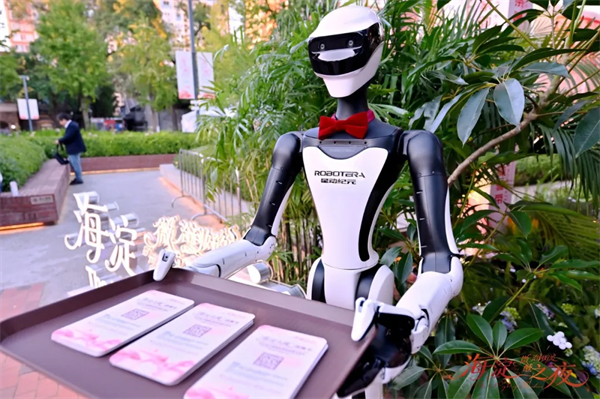
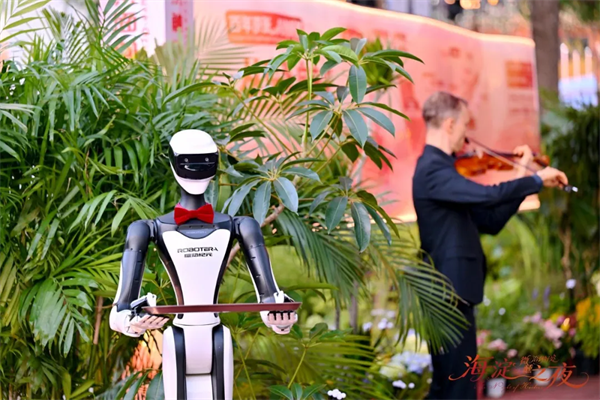
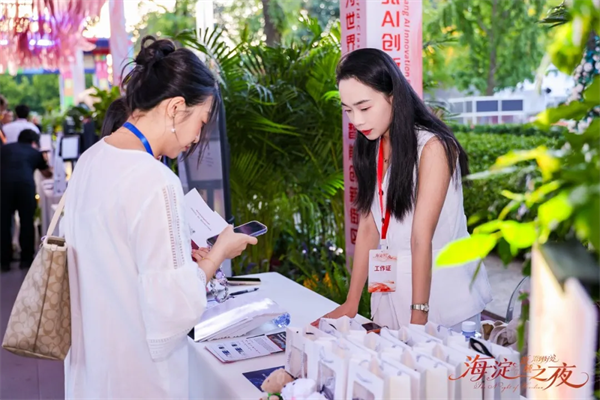
Tonight (September 11), as night falls with a hint of “tipsiness”, stepping to the melodious strains of “The Blue Danube”, guests entering the venue of “The Night of Haidian” at the 2026 CIFTIS are greeted not by an ordinary check-in desk, but by a ROBOTERA Q5 robot. The robot steadily holds a tray, from which guests reach to take a “Business Matching Card” — adding a touch of romance and relaxation to the opening of this tech-filled evening.
A small card, like a key, opens the kaleidoscope of “AI+Services” across Haidian's seven service sectors: education, commerce, technology, health, intellectual property, culture, and finance.
In front of the Zidong Taichu booth, a crowd of curious guests gathered. On the table, a cross-robot data collection hardware and software suite for embodied intelligence — composed of a data collection backpack, a head-mounted camera, a handheld gripper, and an end-effector gripper — was laid out in a row.
According to staff, this system targets embodied intelligence data collection and application scenarios, covering different robot forms such as collaborative robotic arms, mobile robots, and humanoid robots, enabling data reuse across multiple embodiments. Unlike the traditional approach of “collecting one set of data for one robot”, its core lies in establishing a unified data collection and expression system, allowing unified execution end-effectors to adapt to different robot embodiments, thereby reducing the cost of embodied data collection and transfer.
Staff expressed the hope of leveraging “The Night of Haidian” to expand the international circle of friends, allowing more embodied intelligence partners to learn about this system, find landing scenarios in Haidian, and enable robots to evolve from “being able to do something once” to “being able to do it countless times”.
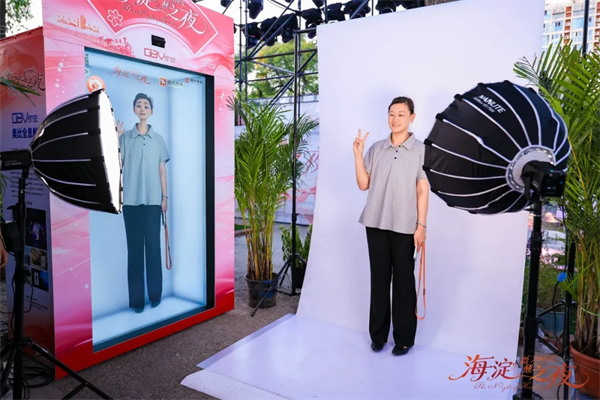
Nearby, Guoshu Technology has transformed AI science popularization into engaging interactive experience products. Intelligent science popularization products such as the “OBVerse Holographic Cabin+Replicated Digital Human”, “OBVerse 3D Cartoon Face Swap”, and “OBVerse Holographic Cabin AI Outfit Changing All-in-One Machine” bring Chinese and foreign guests an immersive digital interactive experience.
Some audience members stand before the screen and transform into cartoon protagonists in one second; others “put on” ethnic costumes, scan a code to save high-definition original images, and print physical photos on-site — technological achievements quietly spread through fun interactions.
Zhiqi Wenhua brought the “Zhiqi AI+Education Public Service Platform”, which takes Z. ai's GLM series large models as its foundation, building a trinity product system of “assisting students, assisting teachers, and assisting management” covering nine core teaching scenarios: student self-study, teacher lesson preparation, classroom management, examination and assessment, Q&A tutoring, homework grading, inquiry-based learning, interactive teaching, and learning analytics.
According to on-site staff, the platform has been piloted in Haidian District and is being promoted citywide, adding momentum to the balanced and high-quality development of regional education.
On-site, enterprises such as ROBOTERA, iFLYTEK, and Kling AI also gathered to showcase new technologies and products including intelligent robots, AI translation glasses, and AIGC video generation.
Beyond technology, a faint medicinal fragrance wafts from the health services sector.
The Xiyuan Hospital of CACMS has set up a Traditional Chinese Medicine (TCM) experience zone on-site, displaying items such as the throat-soothing and moistening Yudong Shuanguo Drink, medicinal-food-homologous health pastries, and TCM blended incense bracelets. Guests can experience them up close.
Some lift teacups to savor the aroma, others pick up bracelets to try on. TCM culture has transformed from “display” to “experience”, stepping out of glass display cabinets into daily life, becoming perceptible, tangible, and approachable.
A guest from the United Kingdom, after tasting medicinal-food-homologous pastries, gave a thumbs-up: “The taste is very special. I'd like to bring some back for my family”.
Turning from the medicinal fragrance, the scene at the Zhongguancun AI Beiwei Community booth presents an entirely different picture.
The large screen plays a community environment video on loop: green tree-lined pathways, co-working spaces, coffee shops, and roadshow venues — all exuding the living atmosphere of an innovation community.
Staff introduce settlement policies on-site, from spatial support to service amenities, extending an invitation to AI entrepreneurs and innovation teams: “Welcome to Beiwei, make Haidian your home, and grow together”. Many guests stop to watch, with some scanning codes on the spot to learn more details.
Finally, in the Centennial Jingzhang AI Innovation Belt display and policy interpretation zone, guests can autonomously plan on-site through an AI Agent (artificial intelligence agent), personally experiencing the interactive charm of “do-it-yourself, intelligent creation” along the Centennial Jingzhang AI Innovation Belt.
A guest exclaimed after the experience: “Haidian has turned policies into experiential services. This openness and efficiency are truly impressive”.
On-site, staff from the Zhongguancun Science City, Haidian Public Security Sub-bureau, and Zhongguancun Comprehensive Bonded Zone conduct policy interpretations, bringing good policies from documents to the guests' side.
After a full tour, “The Night of Haidian” places seven service sectors and frontier topics such as the Centennial Jingzhang AI Innovation Belt and embodied intelligence within the same space. What the robot hands over is a card, but what it delivers is Haidian's invitation: come here, where AI is not a distant concept, but an experienceable, cooperative, and implementable part of daily life.
As night falls with a hint of tipsiness, stepping to the melody of “The Blue Danube”, Haidian's AI story continues forward from this very night.