When early winter reaches the ancient temples of Haidian, all falls quiet. The ginkgoes at Dajue Temple, the yellow leaves at Wofo Temple, the silhouette of the pagoda at Five-Pagoda Temple, the upturned eaves of Wanshou Temple—each is held within red walls and gray tiles. When the ginkgoes turn gold and the bells toll, footsteps crunch through fallen leaves. The season lives not only in what you see, but in the rustle of leaves and the chime of temple bells.
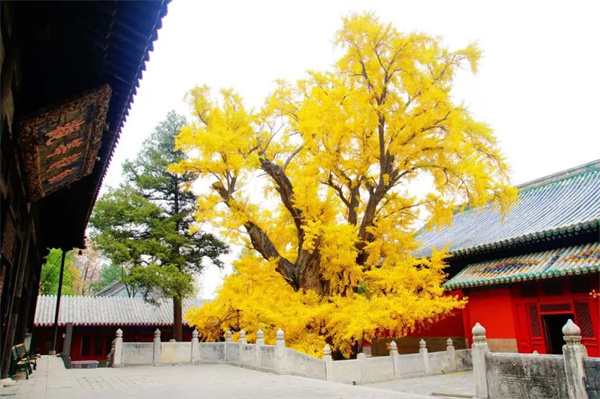
Dajue Temple: A Thousand Years of Ginkgo, a Courtyard Filled with Gold
Photo courtesy of Haidian Youth
The ancient ginkgoes are what visitors most look forward to at Dajue Temple. Before the Hall of Infinite Life Buddha stand two ginkgo trees dating from the Liao Dynasty, more than a thousand years old. One is female and the other male, and together they rank as the finest ginkgoes of the Western Hills.
Emperor Qianlong praised them in verse: "Ancient trunks so vast no count of arms could span them; lush leaves and spreading boughs cast generous shade. Beyond the world, the rise and fall of ages pass like a dream; the founding patriarch, Dading, is but faintly remembered." When the ginkgoes turn gold, the whole courtyard is draped in golden armor. Beneath the millennial trees, light and shadow dapple; red walls and gray tiles glow with a warm sheen in the sun.
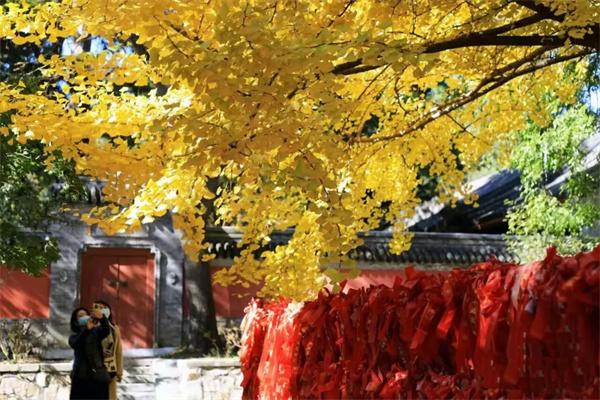
Wofo Temple: Wind Rises in the Yellow Leaf Temple
Photo courtesy of National Botanical Garden
On the east and west sides of the Hall of the Three Buddhas at Wofo Temple in Fragrant Hills stand two ancient ginkgoes. The eastern tree is 22.5 meters tall; the western one stands nearly 20 meters. The east is female and the west male; both are said to have been planted when the temple was founded. When they turn gold in late autumn, Zheng Banqiao's lines — "I ride alone to seek the Yellow Leaf Temple; rain clears, rice ripens in early autumn" — find their footing at last.
When the ginkgoes turn gold, the courtyard is draped in golden armor—the most fitting footnote to the name "Wofo Temple." In late autumn and early winter, yellow leaves pave the paths; once the ancient temple bell sounds, this is the quietest season in western Beijing.
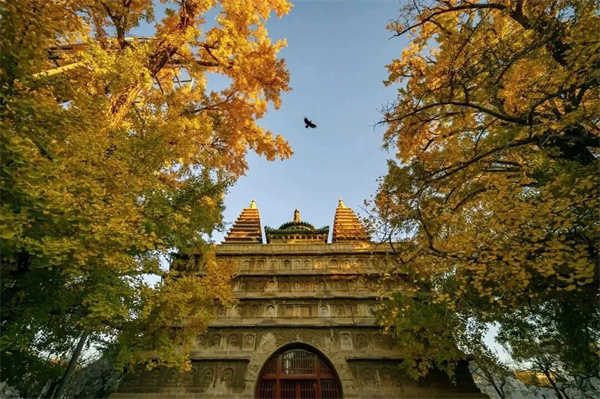
Five-Pagoda Temple: Pagoda Silhouette and Rustling Leaves in Harmony
Photo courtesy of Culture and Tourism Haidian
Before the pagoda at Five-Pagoda Temple stand two massive ancient ginkgoes, 25 meters tall and more than six hundred years old. Each golden autumn, their canopies turn the tree tops gold; in sunlight they lend a brilliant counterpoint to the Diamond Throne Pagoda, forming a striking scene along the Long River (Changhe River).
Hong Liangji, a Qing dynasty man of letters and one of the "Seven Scholars of Piling," visited in autumn and composed an impromptu poem in praise: "By Five-Pagoda Temple stand two remarkable trees; I turn my horse from the road to knock at the Zen gate. Tall boughs seem to rise into the clouds; fallen leaves still flutter halfway down the sky. A few strokes of the stone chime hasten the evening glow; a faint fragrance for ten li (a traditional Chinese unit of length, about 0.5 kilometers) settles on morning robes. East of the neighbouring studios, spring surges like the sea; yet few can match the thick shade that covers this courtyard." Ancient pagoda, Zen gate, fallen leaves, chime and setting sun trace a scene of Zen stillness, solemn and unsullied.
Five-Pagoda Temple offers more than pagoda silhouettes and the sound of leaves—there are also persimmons. The Chinese word for persimmon, shi, sounds the same as the word for "matters," so a tree full of red persimmons becomes a wish that "all matters go as you wish."
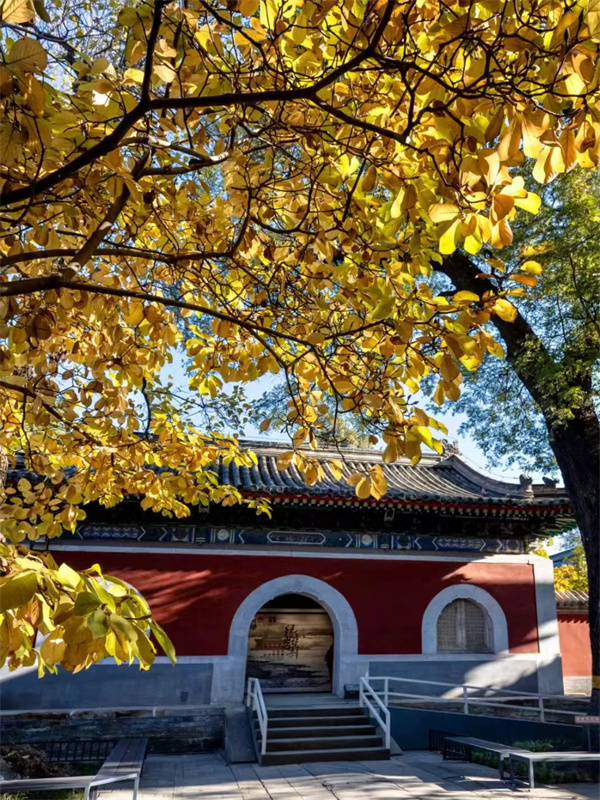
Wanshou Temple: The Sound of the Long River Enters the Temple
At Wanshou Temple, the scene announces itself first through sound, carried over the Long River. When Emperor Qianlong sailed past the temple, he wrote: "Amid the chirp of dew-damp insects, the bank turns and slips away; misty moods and autumn sounds mark another hour."
When the ginkgoes turn gold, fallen leaves lie beneath red walls and glazed tiles, rustling in sheets when the wind passes.